

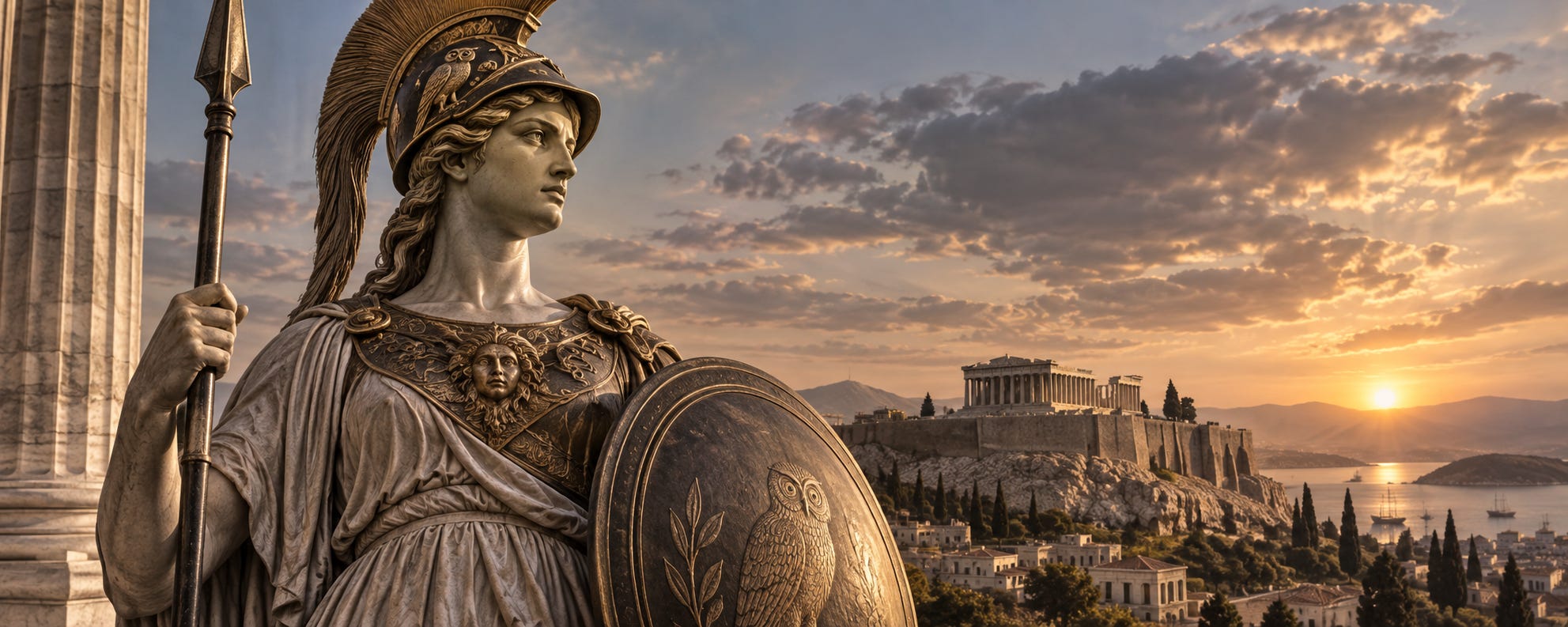
Athena as a Chosen Ideal
Athena has held a particular significance for me for a long time, although not in a religious sense. I do not believe there is a literal goddess somewhere beyond the world who intervenes in human affairs, rewards devotion, or watches my conduct. Yet I am perfectly comfortable describing Athena as my goddess because I think the significance of a god need not depend upon the literal existence of the entity being described.
Gods can be understood as personifications of ideals. We give human form, personality, stories, symbols, and names to qualities that would otherwise remain abstractions. Courage becomes a warrior. Justice holds scales. Victory grows wings. Wisdom acquires a face. Whether the resulting figure exists independently of us is a different question from whether the ideal it embodies is real, intelligible, and worthy of emulation. For me, that is the more important question.
Understood this way, a god can function as something more demanding than a metaphor. An ideal given personality becomes a standard against which conduct can be measured. It gives us an imagined perspective outside our immediate appetites, excuses, fears, and conveniences. We can ask not merely what we want to do, but what the personification of the qualities we claim to value would demand of us. The supernatural observer is unnecessary. The standard itself becomes the witness.
This is what Athena represents to me. She is not simply the goddess of wisdom, nor merely the more intelligent counterpart to Ares. She is not Ares with wisdom added. Her significance lies in the intricate combination of qualities gathered into a single figure: intelligence and warfare, strategy and courage, craft and competence, civilization and force. She possesses power without making power her highest principle. She is capable of violence without being defined by violence. She represents intelligence that can act, strength that can discriminate, and capability ordered toward purpose.
That combination is what is important to me. Wisdom without the capacity to act can become sterile. Strength without wisdom becomes dangerous. Intelligence without duty becomes merely clever. Courage without judgment becomes recklessness. Athena represents none of these qualities in isolation. What makes the archetype compelling is their proper relationship to one another.
This is also why I find Athena more useful as an ideal than a figure representing tranquility, harmlessness, or withdrawal from conflict. Life does not reliably permit those conditions. Duty sometimes requires confrontation. Protection sometimes requires strength. Leadership requires judgment under uncertainty. Responsibility may demand action precisely when action is dangerous, unpleasant, or costly. An adequate ideal must therefore represent not merely serenity in favorable circumstances but the capacity to remain governed while possessing—and sometimes exercising—considerable power.
Importantly, Athena does not represent uncontrolled power subsequently restrained by wisdom. The restraint is not an afterthought. Strategy, judgment, purpose, and command are inherent in the character of her power. Her capability appears as Athena herself does in myth: fully formed and already ordered.
That is why Athena functions for me as a philosophical standard rather than an object of worship. I do not need to believe that Athena literally watches. It is enough to ask whether my conduct could withstand the judgment represented by her. Am I acting from reason or impulse? From duty or appetite? Is strength serving judgment, or has strength begun issuing its own orders? Am I developing capability because duty may require it or because capability itself has become an object of vanity?
The watcher is not the god; it is the standard itself.
And the standard she represents is demanding: intelligence capable of action, strength subordinate to judgment, courage governed by purpose, and power that does not first need to be conquered before it can be commanded.
Athena represents power inherently under command.
Athena Is Not Ares
Athena and Ares are both associated with war, but they represent fundamentally different conceptions of it. Ares personifies violence in its immediate form: aggression, fury, bloodshed, impulse, and the force of conflict itself. He is the charge, the clash, the appetite for battle. His power is direct and emotional.
Athena represents something else. Her domain is strategy, disciplined warfare, judgment, timing, protection, civic order, and the intelligent use of force. She does not reject violence when violence is required, but violence is never the principle that governs her.
That distinction makes all the difference.
Ares is force seeking expression.
Athena is force already under command.
Ares represents what power becomes when impulse leads. Athena represents what power becomes when intelligence, purpose, and restraint lead.
Ares may win battles. Athena wins wars.
The difference is visible even in myth. Ares rushes into conflict. Athena advises, plans, equips, restrains, and intervenes with purpose. He is dangerous because he is powerful. She is formidable because her power is governed, focused, and disciplined.
Athena is therefore not Ares with wisdom added. She represents a different order altogether: capability subordinated to judgment.
That is what makes her the archetype of the warrior-philosopher.
Athena as Warrior-Philosopher
The warrior-philosopher is not a compromise between two identities, half thinker and half fighter. The archetype describes a person in whom capability and judgment have been ordered correctly: strength is available, courage is available, intelligence is available, but none of them acts independently of reason and duty.
Athena fits that archetype because she unites capacities that are often treated as opposites. She is martial without being ruled by aggression; intelligent without becoming detached from action; strategic without reducing everything to manipulation; and powerful without treating power as self-justifying. She does not choose between thought and action. She embodies their integration itself.
That integration matters because neither side is sufficient by itself. A person may understand what should be done and lack the courage, skill, or physical capacity to do it. Another may possess extraordinary capability and lack the judgment to govern it. The warrior-philosopher requires both. Capability expands what can be done; philosophy determines what should be done.
Athena represents that hierarchy clearly. Her strength does not compete with wisdom. Her courage does not override judgment. Her strategic intelligence does not excuse injustice. Her capacity for violence does not create permission to use it. Each capability has a place, and that place is subordinate to purpose.
This is why she is a more complete warrior archetype than the merely formidable fighter. The dangerous person is not necessarily disciplined. The intelligent person is not necessarily wise. The courageous person is not necessarily just. The warrior-philosopher is defined not by possession of these qualities but by their governance.
Virtue governs. Capability serves.
Athena gives that order a recognizable form. She is not admirable because she is powerful, but because power appears integrated into a larger structure of judgment, duty, restraint, and purpose. The same holds for the warrior-philosopher; the objective is not simply to become more capable. It is to become more capable without allowing capability to become sovereign.
The warrior-philosopher trains toward that condition.
Athena symbolizes it already achieved.
Power Inherently Under Command
Athena is not a Stoic. The mythology surrounding her predates Stoicism by centuries, and there is no need to force a historical connection that does not exist. The point is not that Athena somehow anticipated the school. The point is that the order she represents is strikingly compatible with it.
If we ask her why wisdom should govern strength, why courage should remain subordinate to judgment, why appetite should not outrank duty, or why power should be restrained by purpose, Athena almost makes the question seem unnecessary. To Athena, the questions themselves might seem absurd, and she would respond simply:
What else is there?
That is what makes her such a compelling archetype. Stoicism teaches a hierarchy in which reason governs, virtue sets the standard, and externals remain subordinate. Athena personifies a similar order: intelligence, strength, courage, strategy, and force are all present, but none is sovereign by itself.
For us, that hierarchy is not automatic. We have to build it, reinforce it, and test it. Strength can become vanity. Intelligence can become cleverness without wisdom. Courage can become recklessness. Anger can seize command. Capability can become its own justification. Strategic Stoicism is the deliberate work of preventing that disorder.
Athena represents the condition toward which that work aims.
Stoicism teaches the hierarchy. Athena personifies the hierarchy. Strategic Stoicism trains us to make that hierarchy operational.
That is why Athena is important to me. I do not need her to exist as a supernatural being. I need only to understand what she represents and measure my own conduct against that standard.
The ideal is severe but clear: become capable, become disciplined, become useful, become dangerous if duty requires it—but never allow capability to become sovereign over judgment.
The Strategic Stoic trains toward what Athena already represents: power inherently under command.