

Lines of Separation is a series dedicated to comparing and contrasting Stoicism and other schools of thought. An analysis of where they align, where they diverge, and occasionally where a single principle may decisively divide them.
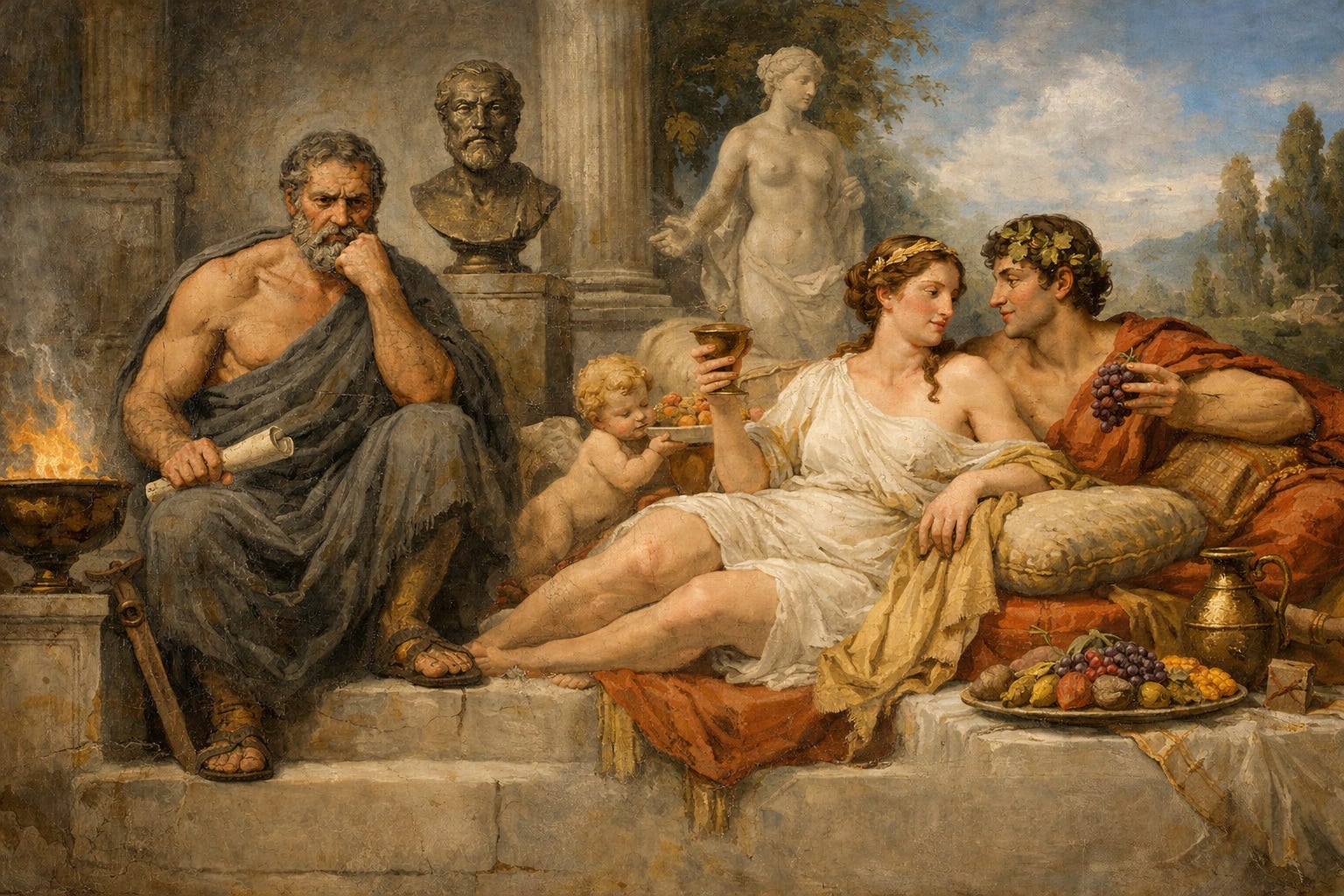
Epicureanism and Stoicism are often treated today as interchangeable, or at least adjacent, “ancient wellness philosophies.” Both are reduced to mood management, stripped of rigor, and folded into a vague ethic of calm. This flattening does a massive disservice to both traditions.
In reality, Epicureanism and Stoicism are coherent, demanding, and ethical systems—but they answer a fundamental question differently:
Is the good life built by aiming directly at tranquility, or by aiming at virtue and accepting tranquility only as a consequence?
To answer that honestly requires understanding Epicureanism as it actually was, not as a modern pleasure-maximizing caricature.
Epicureanism, Properly Understood
Epicureanism is not indulgence. It is not luxury. It is not “do whatever feels good.” Epicurus defined the good as pleasure (hēdonē), but he defined pleasure with extreme restraint. True pleasure consists of two conditions:
Ataraxia—freedom from mental disturbance
Aponia—absence of bodily pain
This is not a call to stimulation but to stability. The Epicurean project is fundamentally disturbance-minimizing, not pleasure-maximizing. Epicurus was explicit that excess desire is the primary source of human suffering. To combat this, he classified desires with surgical clarity:
Natural and necessary (food, shelter, friendship)
Natural but unnecessary (luxury, refinement)
Empty desires (status, fame, wealth, power)
Only the first category is worth pursuing without reservation. The rest introduce anxiety disproportionate to their reward.
Epicurean life strategy is therefore conservative and prudential:
Reduce exposure to fear, especially fear of death and divine punishment.
Simplify material needs.
Avoid status competition.
Withdraw from unnecessary danger, including political life when it threatens peace.
Cultivate friendship as essential to tranquility.
Epicurean ethics follow the same logic. Justice is understood as a mutual non-harm agreement, not because justice is sacred in itself, but because injustice reliably destroys peace of mind. Virtue matters—but instrumentally. It is valuable because it secures tranquility.
This is a disciplined, ethical philosophy. But its end is clear: tranquility is the goal.
This is a far cry from the modern interpretation of “Epicurean Delights” and the association with hedonism. Epicurus approved of no such things.
Stoicism in Contrast: Virtue as the Target
Stoicism begins from a different first principle.
For the Stoics, virtue is the only true good. Living in accordance with reason and nature—not comfort, not pleasure, not tranquility—is the aim. Everything else is secondary. Pleasure and pain, health and illness, wealth and poverty are classified as indifferents. They may be preferred or dispreferred, but they carry no moral weight.
Tranquility is not rejected in Stoicism—but it is not pursued directly. It arises, if it arises at all, as a by-product of correct judgment, duty fulfilled, and a disciplined character.
Stoic ethics are intrinsic and non-negotiable:
Justice is required even when it is costly.
Courage is demanded even when it hurts.
Right action does not depend on outcome.
Duty to virtue is non-negotiable.
Stoic life strategy reflects this orientation:
Prepare for adversity rather than avoid it.
Train for hardship instead of designing life to minimize risk.
Accept fate as raw material for virtue.
Engage with social and civic roles as duty and part of human nature.
Where Epicureanism asks, “How do I avoid disturbance?”
Stoicism asks, “How do I embrace disturbance and act rightly, whatever comes?”
Where They Overlap: The Often Missed Points
Despite their differences, the two schools share significant ground:
Both are hostile to excess desire.
Both reject status obsession and luxury.
Both impose discipline and restraint.
Both function as therapeutic philosophies aimed at stabilizing the human mind.
Neither school is indulgent. Neither promises constant pleasure. Both are, in practice, austere. This overlap explains why modern treatments often blur them together—and why that blurring is a mistake.
The Fault Lines
The disagreement is not about tactics. It is about value theory.
What is the good?
Epicureanism: Tranquility/pleasure is the good; virtue serves it.
Stoicism: virtue is the good; duty is the obligation; tranquility may follow.
Risk and engagement.
Epicureanism favors withdrawal when risk threatens peace.
Stoicism treats duty and engagement as part of nature.
Suffering.
Epicureans design life to minimize suffering.
Stoics train to endure and transform suffering.
Metaphysical posture (secondary but explanatory).
Epicurean atomism denies providence.
Stoic logos frames fate as rational order.
These are not cosmetic differences. They produce fundamentally different lives.
Two Different Answers to the Same Human Problem
Epicureanism produces quiet, insulated lives: simple, careful, friendship-centered, and intentionally low-risk.
Stoicism produces duty-bound lives: resilient, outward-facing, prepared for loss, obligation, and hardship.
Both are serious. Both are ethical. Both work—if practiced honestly. But they cannot be collapsed into one another without losing their integrity. Epicureanism aims at tranquility and uses virtue as a means. Stoicism aims at virtue and accepts tranquility only as a consequence.
Confuse those aims, and both philosophies dissolve into comfort-seeking platitudes.
Understand them clearly, and you can choose—deliberately—what kind of life you are actually building.
Personal Choice
As I study these systems, I must admit there is a genuine attraction to Epicureanism. It poses a simple, disarming question—one that is difficult to dismiss honestly: if you are not happy, or at least tranquil, what is the point? That question alone elevates Epicureanism from caricature to a philosophy worthy of serious consideration.
Viewed from the end of a life rather than the middle of one, the argument has force. A life spent in constant agitation, fear, or misery does not intuitively appear well lived. For many people, the Epicurean aim of tranquility—freedom from disturbance, freedom from unnecessary pain—is not only reasonable but sufficient. And for those whose lives allow it, this is not cowardice or indulgence; it is coherence. Epicureanism answers the human problem of anxiety with restraint, clarity, and discipline.
Yet for me, that answer is incomplete.
One word changes the equation: duty.
Epicureanism can justify ethical behavior, loyalty, and restraint, but it cannot demand them when they threaten tranquility. Its ethics are prudential—sound, rational, and often admirable—but ultimately conditional. Duty is accepted when it preserves peace of mind, avoided when it endangers it. That is not a flaw in Epicureanism; it is a direct consequence of its first principle.
Stoicism begins elsewhere. It does not ask first whether an action will make life calmer or more pleasant. It asks whether the action is right—whether it accords with reason, justice, and one’s role as a social being. Tranquility may follow, or it may not. That is not the measure and not relevant.
For someone whose life includes non-negotiable roles—father, husband, teacher, protector, provider, citizen—this distinction matters. Some burdens are not chosen because they promise happiness. They are selected because abandoning them would be a form of moral and ethical failure.
Stoicism does not require that duty be pleasant. It requires that it be fulfilled.
Epicureanism governs appetite by retreat. It avoids the storm by leaving the sea. It narrows desire until pain no longer enters, then calls this freedom (and it may be). This is skillful—but it is defensive skill, not virtuous strength, and not duty.
Epicureanism offers peace. Stoicism offers structure. Epicureanism minimizes disturbance. Stoicism accepts disturbance as the cost of living rightly. For many, peace is the highest good. For me, it cannot be.
A life can be tranquil and still be insufficient.
A life ordered by duty, even at the cost of comfort, cannot be dismissed so easily. I choose only the peace earned through duty, and if peace never comes, so be it.
That is why Stoicism, not Epicureanism, is the philosophy I decide to live by.