

Author’s Note: I also write about AI, computer science, and the changing nature of professional work on Medium. Whenever I argue that people should prepare for AI by becoming more capable—more technical, more adaptable, better at higher-order thinking—I eventually hear some version of: “But AI will surpass that too, so what’s the point?” This post is the answer—and a case study in a principle I have argued here before: preparation is not worry; it is the cure for it.
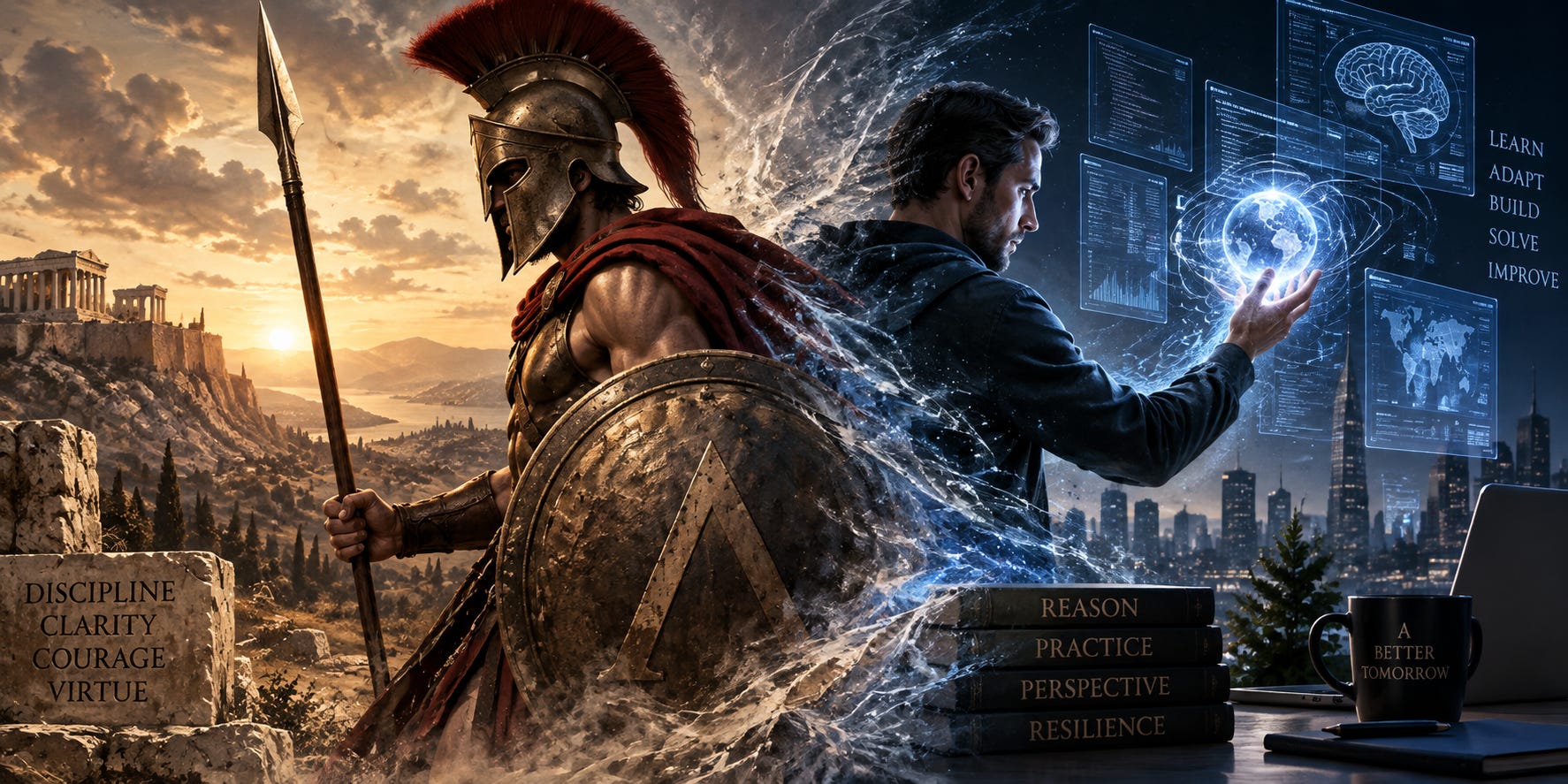
The Future Is Not Yours to Control
There is a particular kind of fatalism that likes to disguise itself as foresight.
Why get better at programming if AI will eventually program better than you? Why become a stronger engineer if AI will eventually engineer better than you? Why study mathematics, science, architecture, strategy, or anything difficult if some future machine may eventually surpass you anyway?
Because that future does not exist yet.
Seneca warned that we suffer more often in imagination than in reality. AI fatalism does exactly that: it suffers tomorrow’s defeat in advance and then calls the surrender realism.
The Stoic does not surrender today because tomorrow may change the terrain. He studies the terrain that exists, prepares for the terrain that is coming, and adapts when reality changes.
Imagine telling Richard the Lionheart or William Wallace, “Stop training. Throw away your shields and swords. Gunpowder weapons are coming.”
They would laugh at you. Not necessarily because they doubted you, but because the proper response would be, “Perhaps. But they are not here now, and I have work to do—now.”
The possibility that someone may invent a better weapon tomorrow is not a reason to throw away your sword today. You train with the weapon you have. You prepare for the weapon that may come next. When the battlefield changes, you change with it.
Preparation was never a guarantee of victory. It was and remains a way of meeting uncertainty from the strongest position available to you.
The No-Regrets Bet
There is a simple way to think about preparation under uncertainty: choose the course of action that leaves you stronger and more resilient across the greatest number of plausible futures.
Consider a common climate-change argument. Suppose a skeptic were ultimately correct about some major causal claim, but in preparing for the threat, we reduced pollution, improved efficiency, conserved resources, and developed cleaner technologies anyway. What exactly was lost? Even if part of the prediction proved wrong, much of the preparation still left us better off.
AI presents the same choice.
Suppose AI progress slows considerably. Becoming a better mathematician, scientist, engineer, programmer, strategist, or thinker was obviously worthwhile.
Suppose AI keeps advancing and pushing the human competence frontier upward. Deeper knowledge, greater adaptability, and stronger judgment help me keep moving with it.
Suppose AI eventually becomes so capable that my expertise provides no meaningful economic advantage at all. Being less intelligent, less educated, and less capable would not have prevented that outcome.
If AI eventually makes my expertise obsolete, ignorance would not have saved me. Greater knowledge may even expose options I cannot see from where I stand today.
This is fundamentally Stoic. Epictetus begins the Enchiridion by dividing reality into what is within our power and what is not. I do not control how quickly AI improves, what models corporations release, what governments regulate, what industries disappear, or what the labor market looks like ten years from now. Those things are terrain.
What is at least partly mine is how I meet that terrain: what I learn, how well I think, how effectively I use the tools available to me, how resilient I become, and how quickly I adapt.
Stoicism does not promise that preparation guarantees victory. That would confuse action with outcome. It asks us to see reality clearly, train deliberately, act where action is possible, and stop demanding guarantees the universe never offered.
The warrior trains because training improves his position in battle, not because the gods signed a contract promising that he will survive it.
That is the no-regrets bet. Across almost every plausible future short of complete human cognitive obsolescence, being smarter, stronger, more capable, and more adaptable improves my position. And if complete obsolescence arrives anyway, I would rather meet it as the strongest version of myself I managed to build than as someone who surrendered years earlier because defeat was theoretically possible.
The Obstacle Becomes the Way
Marcus Aurelius goes further than telling us merely to endure obstacles. In Meditations 5.20, he writes:
The impediment to action advances action. What stands in the way becomes the way.
That distinction is core to my philosophy of both AI and life.
The Stoic response is not always to work around an obstacle. Sometimes you study the obstacle until you discover that the answer is inside it—that the thing limiting you can be transformed into the means by which you advance.
I learned this long before AI.
I am dyslexic and dysgraphic. Seeing language and sequences out of order was an obstacle until I learned to exploit the same tendency as an ability to examine problems from multiple directions. Where another person naturally follows a line left to right, I am comfortable reversing it, rotating it, and attacking it from another angle. I used that not only to master English but also later to learn Greek, where flexible word order has no effect on me. Word order is always strange to me, so none of it is particularly strange.
The obstacle becomes the way.
I was also too tall and long-limbed to fight the way smaller, faster fighters did. I spent years trying to overcome that and failing until my instructor told me to stop trying to be fast. Become enormous. Become so strong that the other man may hit first, but you hit last—because it ends when you hit back. I went from a gangly 160-pound teenager to a 275-pound man with four black belts.
The obstacle becomes the way.
My thinking is naturally rigid, procedural, and algorithmic. I could have spent my life wishing I were a more instinctive free thinker. Instead, I turned that rigidity into logic, mathematics, programming, and systems analysis.
The obstacle becomes the way.
AI should be approached exactly the same way.
If AI is better than you at routine programming, do not quit programming. Use AI to become capable of designing and building systems you could never have built alone.
If AI writes faster and better than you, do not stop writing. Use that speed and quality to explore more ideas, attack your own arguments harder, revise more aggressively, and spend more of your effort deciding what you actually mean.
If AI can analyze more information than you can hold in your head, do not surrender analysis. Use it to extend the reach of your judgment.
The thing threatening to make the old version of your skill obsolete may be precisely the thing that allows you to build the next version of that skill.
Do not merely endure the obstacle. Recruit it. For me, AI is not just the thing moving the frontier; it is also the weapon I use to move with it.
When the Game Actually Changes
The strongest objection remains: what happens when AI moves upward again?
Today it may replace routine coding. Tomorrow it may outperform humans at architecture, planning, scientific analysis, medicine, validation, and increasingly sophisticated forms of judgment.
Fine. Then the frontier moves again.
If the machine becomes better at coding, move toward architecture. If it becomes better at architecture, move toward problem framing, systems judgment, strategy, or whatever higher-order work remains. If the frontier keeps moving, keep adapting.
The point is not to discover some magical sanctuary of human ability that AI can never touch. I do not know whether such a sanctuary exists. The point is to remain capable, useful, and adaptable for as long as the environment permits it.
There may eventually come a point where the change is no longer incremental. If AGI or ASI reaches a level where human cognitive labor has little or no economic value, then we are no longer discussing programming careers, engineering careers, or whether someone should learn more mathematics.
That is not a career-planning problem.
It is a civilization problem.
No one has a reliable guidebook for that world.
Stoicism is not a prophecy machine. It is a discipline for acting rationally under conditions we do not control. I will not use a hypothetical future paradigm as an excuse to weaken myself in the present one.
If the rules change, I will learn the new rules. If the battlefield changes, I will take to the field as the strongest version of myself I can build. If the entire structure of human work collapses, then we all have a problem larger than professional strategy. I’ll worry about dealing with that if and when it happens—stoically and prepared.
Play the Strongest Hand You Can
I do not know how capable AI will become, how quickly it will get there, or what parts of human work it will eventually absorb.
Neither does anyone else.
I hold a PhD in AI and have worked professionally in and around this field for almost three decades, and I can assure you: nobody knows where this ends. Not the people announcing that AI will take over the world next Tuesday, and certainly not the people declaring that AI has already peaked. We have opinions, some far better informed than others, but they remain opinions.
Pretending otherwise is prediction masquerading as certainty.
What I do know is that I can affect the condition in which I meet that future. I can learn more, think better, strengthen my judgment, train harder, exploit the tools available to me, and become more adaptable.
That does not guarantee victory.
Stoicism never promised victory.
It asks a different question: What is yours to do now?
Preparation is mine. Training is mine. Judgment is mine. Adaptation is mine. The outcome never was.
Perhaps AI eventually surpasses everything I can do.
Okay.
Being weaker would not have prevented that.
I cannot control the hand the future deals me, but I can make damn sure I am a better player when the cards arrive.
Prepare for the world that is coming. Adapt when it arrives. Above all, never confuse uncertainty about victory with a reason to surrender before the fight begins.