

Lines of Separation is a series dedicated to comparing and contrasting Stoicism and other schools of thought. An analysis of where they align, where they diverge, and occasionally where a single principle may decisively divide them.
Introduction
Nietzsche is not an easy contrast for Stoicism because he is not soft, and neither is Stoicism.
Nietzsche is not a philosopher of comfort, safety, obedience, weakness, or sentimental consolation. Neither is Stoicism. Nietzsche does not ask man to become harmless. He does not treat suffering as an injustice merely because it wounds. He does not bow before the crowd and call that humility. Nietzsche is dangerous because he is often strong, and because many of the things he attacks deserve to be attacked.
Stoicism and Nietzschean thought appear, at first glance, to stand on similar ground, ironically despite Nietzsche’s explicit rejection of Stoicism. Both despise self-pity. Both reject comfort as the measure of life. Both distrust the herd. Both demand discipline, hardness, endurance, and self-overcoming. Both regard the ordinary pursuit of pleasure, praise, wealth, safety, and public approval as beneath the serious man.
I have a profound affinity for Nietzschean thought: its suspicion of herd morality, its demand for ascent, its refusal to make comfort the measure of life, and especially its contempt for weakness.
But affinity is not allegiance.
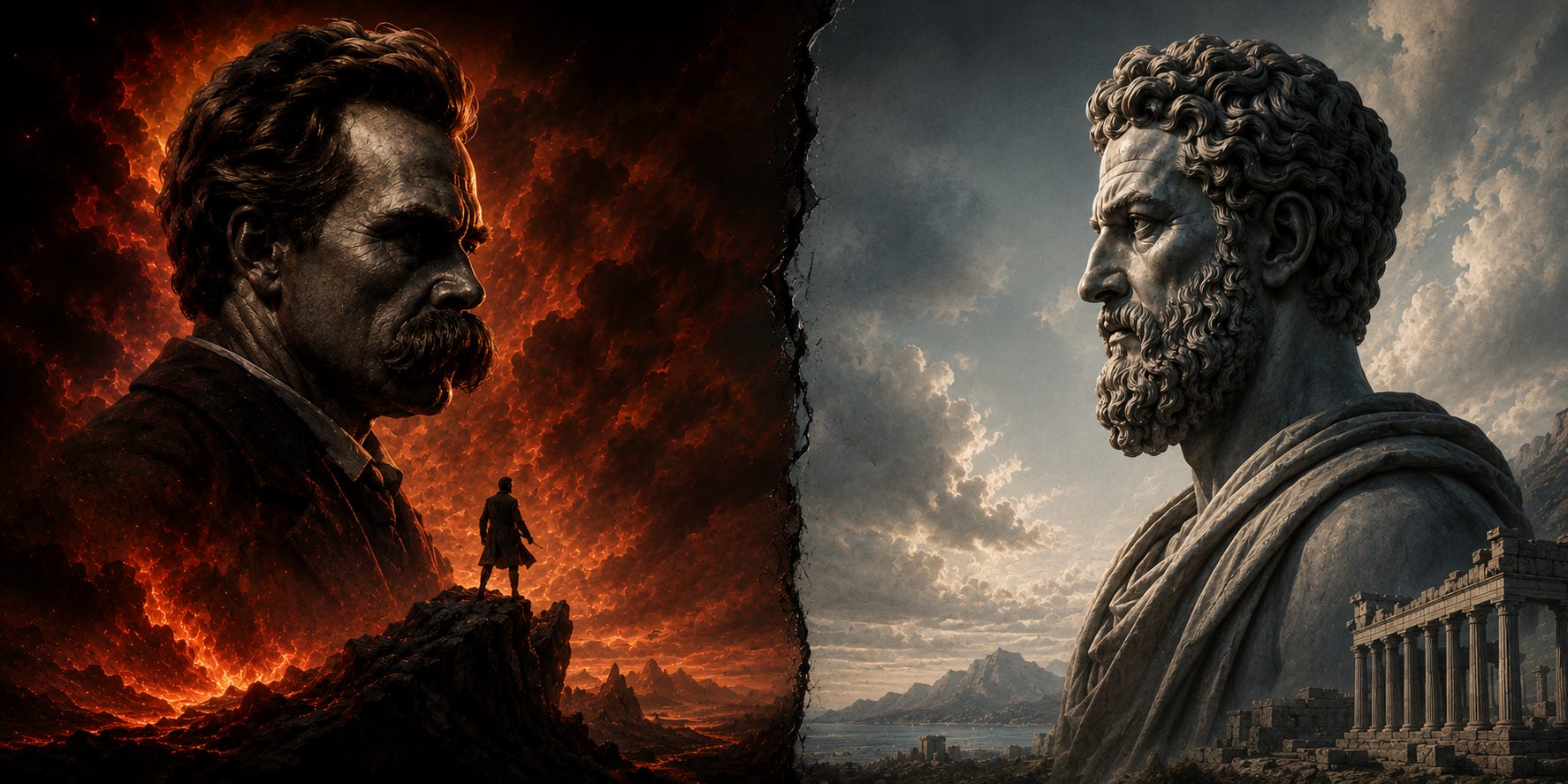
Nietzsche and the Stoics may stand side by side against softness, but they do not march under the same banner. They agree that man must overcome himself. They disagree over what self-overcoming is to accomplish.
Nietzsche teaches the will to rise.
Stoicism teaches the will to remain under command.
Nietzsche gives the strong man fire. Stoicism gives him law.
That is where the line of separation begins.
A Worthy Opponent
Nietzsche should not be dismissed as a mere advocate of ego, cruelty, chaos, or indulgence. That is the shallow reading, and it is unworthy of the comparison.
Nietzsche understood that much of what passes for morality is not virtue at all. It is resentment with better manners. It is weakness seeking protection. It is mediocrity demanding that excellence apologize for itself. It is envy dressed as justice, fear dressed as humility, and cowardice dressed as compassion.
That critique has force.
There are forms of morality that do not elevate the soul but domesticate it. There are forms of pity that do not help the suffering but enthrone weakness. There are forms of equality that do not seek justice but punish distinction. Nietzsche saw this with brutal clarity.
In that sense, Nietzsche is useful. He is a hammer against false virtue, and he often strikes true.
The Stoic can respect this. I respect this. However, while a hammer can destroy idols, it cannot build a complete discipline of the soul.
Nietzsche can diagnose resentment, softness, herd morality, and life-denial with terrifying effectiveness. But diagnosis is not sovereignty. Destruction is not architecture. Fire is not law.
Stoicism does not reject Nietzsche because he is too hard or because he is wrong. Stoicism rejects Nietzsche where he is not governed enough.
Nietzsche rejects Stoicism because he sees it as too governed, too moralized, and too hostile to the wildness of life.
In this, he is mistaken.
The Surface Alliance
The surface alliance between Stoicism and Nietzsche begins with their shared contempt for self-pity, cowardice, and surrender.
Both reject the soft life. Both reject the man who makes comfort his highest aim. Both reject the smallness of living for praise, reputation, public approval, and the emotional permission of the crowd.
The Stoic says: These things are externals.
Nietzsche says: These things are often symptoms of herd existence.
For a time, the two seem to walk together.
But the resemblance conceals a deeper division.
Nietzsche’s concern is ascent. He asks whether man can rise above inherited values, break the idols of the herd, overcome weakness, and become something higher. His eye is drawn upward: rank, height, vitality, force, creation, self-overcoming.
The Stoic’s concern is command. He asks whether man can govern judgment, discipline passion, act justly, endure fortune, and remain ruled by reason rather than impulse. His eye is drawn inward: assent, virtue, self-mastery, duty, rational order.
Both demand hardness, but they define the final test differently.
For Nietzsche, the question is whether man can rise.
For the Stoic, the question is whether man can remain virtuous while rising, falling, suffering, ruling, losing, aging, or dying.
Nietzsche’s strong man rises above the herd.
The Stoic strong man rises above himself.
Nature: Chaos or Rational Order
Nietzsche’s attack on Stoicism is sharpest when he attacks the Stoic command to live according to nature.
His criticism is serious. Nature is not gentle, sentimental, or humane. Nature is violent, fertile, indifferent, wasteful, magnificent, cruel, creative, destructive, and merciless. It does not reward virtue with comfort. It produces beauty and disease, strength and deformity, birth and rot.
Nietzsche sees this and accuses the Stoic of dishonesty. How can one “live according to nature” when nature itself is indifferent beyond measure? Is the Stoic really following nature, or projecting Stoic values onto it and pretending to obey them?
This deserves an answer.
Stoicism does not command man to imitate every event in nature. The Stoic does not look at a storm and conclude that he should become chaos. He does not look at a predator and conclude that appetite is justice. He does not look at disease and conclude that destruction is virtue.
To live according to nature does not mean to imitate everything that exists.
It means to understand what kind of thing one is.
A wolf lives according to wolf nature. A vine lives according to vine nature. A storm lives according to storm nature. A man lives according to human nature, or he lives beneath himself.
Human nature is not mere appetite, domination, impulse, hunger, anger, rank, or force. These exist in man, but they are not the highest part of man. The distinct and unique nature of man is rational judgment. Man can examine impressions, choose assent, distinguish appearance from truth, govern desire, and act from principle rather than impulse.
That is what the Stoic means by nature.
Nietzsche is right to reject a sentimental nature. But Stoicism does not espouse or require sentimental nature. Stoicism requires a rational man.
Nietzsche sees chaos and wants man strong enough to rise within it.
Stoicism sees chaos and wants man rational enough not to become it.
Power and Passion
Nietzsche’s philosophy speaks powerfully to men who cannot be satisfied by safety.
He does not make smallness holy. He does not tell the strong man to apologize for strength. He does not treat ambition, distinction, intensity, and excellence as moral embarrassments. A philosophy unable to speak to strength is not fit for strong men.
There is nobility in that, and again, I admire it and often agree with it.
But Stoicism does not answer Nietzsche by defending weakness or fearing strength. The Stoic does not fear strength. He fears corruption. He does not fear power. He fears slavery to power. He does not fear ascent. He fears ascent without wisdom.
Nietzsche sees power as expansion, height, overcoming, vitality, creation, and force. Power is life pressing beyond its current form.
Stoicism sees power differently.
Power is not evil, but neither is it good. Power is raw material. It is an external condition, a capacity, a force, a tool. It can defend or destroy. It can serve justice or vanity. It can make a man useful, or reveal that he was never governed.
Power does not become good by being strong.
Power becomes worthy only when ruled by virtue.
The same is true of passion. Nietzsche is right to distrust any philosophy that turns man into a tame animal. But Stoicism does not demand tameness as many mistakenly believe. It demands command.
Nietzsche fears the weakening of passion.
Stoicism fears the enthronement of passion.
Both Nietzsche and Stoicism concede passion may supply energy, but only Stoicism asserts it may not sit on the throne.
Nietzsche sees power as the proof of life.
Stoicism sees self-command as the proof of power.
Command is sovereign, not power.
Herd Morality and Judgment
Nietzsche’s critique of herd morality remains one of his most valuable.
He saw that the crowd often uses moral language to protect its own weakness. The herd does not merely fail to rise; it often resents those who do. It does not merely lack greatness; it often condemns greatness as arrogance. It brands danger, excellence, hierarchy, and strength as immoral because they expose its own smallness.
Nietzsche saw the sickness in this, and he was right.
The Stoic agrees that the herd is not an authority. The many do not decide what is good by counting heads. Popular approval does not make an action virtuous. Public hatred does not make an action vicious. A crowd may praise cowardice, condemn courage, reward flattery, punish honesty, worship wealth, envy excellence, and mistake emotional contagion for moral truth.
Neither Nietzsche nor the Stoic kneels before the herd.
But the Stoic rejection of the herd is different from Nietzsche’s. Nietzsche rejects the herd because it restrains greatness. Stoicism rejects the herd because it corrupts judgment.
Nietzsche’s concern is that herd morality suppresses higher types.
Stoicism’s concern is that herd morality teaches men to misidentify the good. The crowd treats wealth as good, poverty as evil, status as good, obscurity as evil, pleasure as good, pain as evil, victory as good, defeat as evil.
The herd does not know what to value; that is the Stoic accusation.
Nietzsche teaches contempt for the herd.
Stoicism teaches independence from it.
The Pressure Test
Every philosophy of strength must be tested under power.
Suffering tests courage. Power tests justice.
Give the man strength. Give him status. Give him money. Give him command. Give him followers. Give him the ability to punish enemies, reward allies, satisfy appetites, silence critics, and bend circumstances toward his own will.
Then ask what governs him.
This is where Nietzsche becomes dangerous.
Not because Nietzsche commands cruelty. That is too crude. But Nietzsche’s philosophy does not sufficiently bind strength to justice. It does not give temperance enough authority. It leaves too much room for the strong man to become his own justification.
The strong man does not need help becoming dangerous. He needs a law higher than his own appetite for ascent.
Stoicism supplies that law.
For the Stoic, strength is not permission. Power does not exempt a man from justice. Victory does not excuse cruelty. Superiority does not annul duty. The fact that one can dominate does not mean one should.
Power changes circumstances.
It may not change virtue.
This is where Stoicism is harder, not softer. It tells the powerful man that his strength does not free him from virtuous command; it increases the necessity of virtuous command. His anger reaches farther. His vanity does more damage. His injustice has more victims.
Nietzsche teaches the strong man not to bow before the herd. That is valuable. But Stoicism teaches the strong man not to bow before himself.
That is superior.
The Final Test: Defeat
Power tests justice.
Defeat tests sovereignty.
Here Stoicism becomes almost impossible to surpass.
Nietzsche is powerful when man can rise. He is magnificent when man can overcome, transform, create, intensify, and ascend. He speaks to the man who refuses to be reduced by the herd, who refuses comfort as an ideal, who refuses inherited limits, who refuses to make weakness sacred.
But what happens when ascent is impossible?
What happens when sickness remains? When age advances? When the body declines? When the war is lost? When the reputation is destroyed? When the loved one dies? When exile is permanent? When death is certain and near?
A complete philosophy of ascent must answer what remains when ascent is denied.
Stoicism was built for this test.
Stoicism does not require victory to preserve greatness. It does not require health, wealth, office, reputation, youth, beauty, conquest, social rank, or external success. It tells man these things are not the good. They are not the measure of his soul. They are not the source of his freedom.
Nietzsche is strongest where man can impose form upon life.
Stoicism is strongest where life imposes form upon man.
The Stoic question is not merely, Can you overcome?
The Stoic question is, Who are you when you cannot?
Nietzsche can harden a man against the herd.
Stoicism can harden him against fate.
Conclusion: Fire Under Law
Nietzsche is not worthless. He is not soft. He is not an adversary to be dismissed. He is dangerous because he is strong, and because much of what he attacks deserves to be attacked.
His contempt for weakness and suspicion of herd morality is valuable. His demand for self-overcoming and refusal to make comfort the measure of life is valuable. His hammer against false virtue often strikes true.
But Nietzsche is incomplete.
He gives the strong man fire without sufficient law. He teaches ascent, but does not sufficiently govern ascent. He teaches suspicion of the herd, but does not fully solve the problem of the self-herd. He teaches power, but does not subordinate power to wisdom, justice, courage, and temperance.
Stoicism does not reject Nietzsche because Nietzsche is weak.
Stoicism rejects Nietzsche because strength is not enough.
Strength must be governed. Power must be judged. Passion must be commanded. Ascent must be measured against virtue. The will must not merely rise; it must answer to reason.
Nietzsche awakens the warrior. Stoicism governs him toward virtue.
Nietzsche breaks the idols of the herd. Stoicism builds the discipline of the soul.
Nietzsche exposes false virtue. Stoicism defines true virtue.
Nietzsche teaches man to despise weakness. Stoicism teaches him not to be ruled by the need to prove strength.
Nietzsche teaches the will to rise.
Stoicism teaches the will to remain under command.
That is the line of separation.