

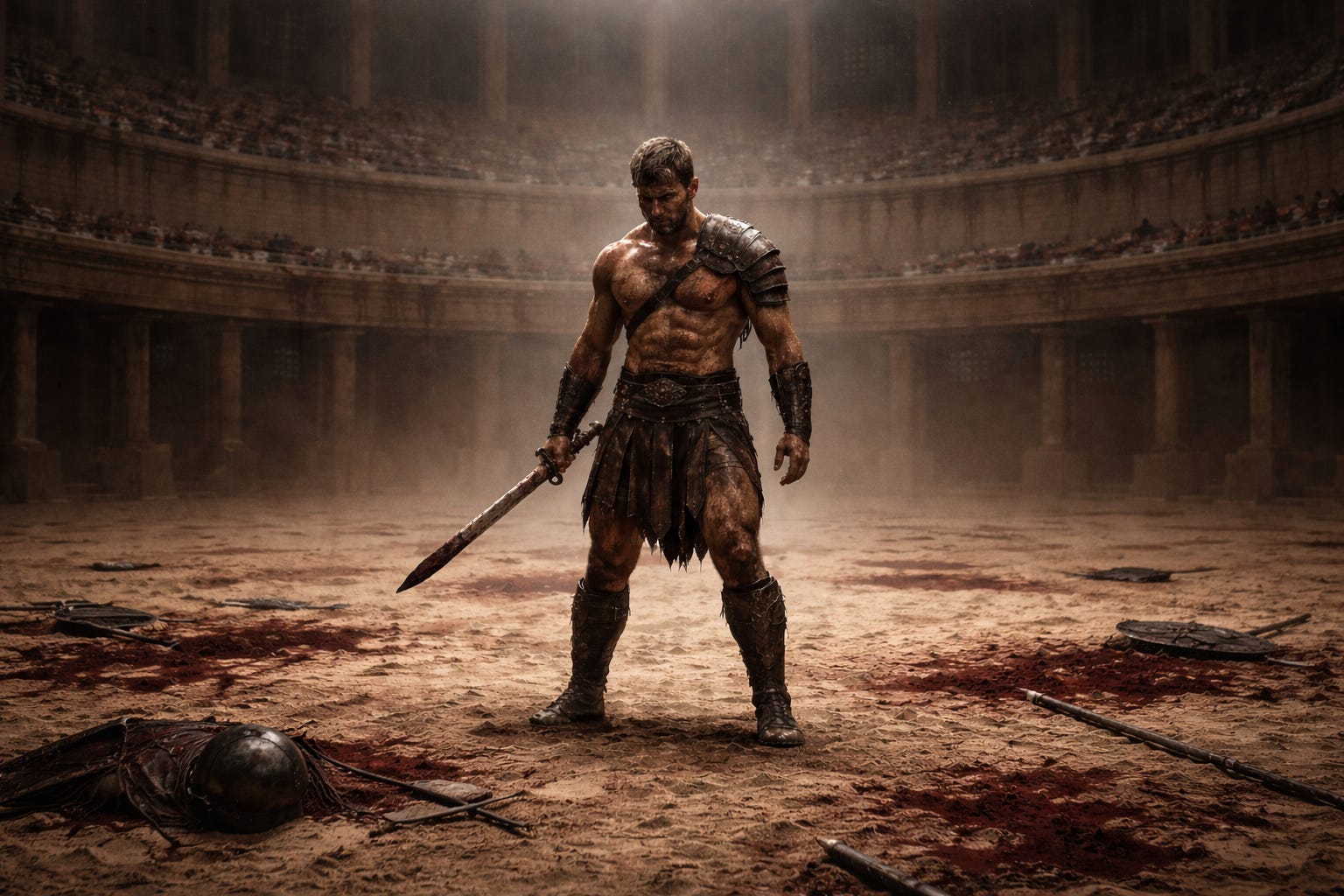
Modern “stoicism” has been flattened into a sedative.
Don’t worry.
Let it go.
Be calm.
That is not Stoicism. That is anesthesia. It’s also a good way to get your ass kicked. The Stoics did not teach passivity. They taught preparedness without panic.
When people see disciplined preparation—physical training, contingency planning, and deliberate exposure to hardship—they often ask a revealing question: “What are you so worried about?” “Why don’t you just relax and enjoy life?” The assumption is simple and wrong: preparation is taken as evidence of fear and anxiety.
The Stoic answer is the opposite.
My answer is the opposite: “I worry about nothing. I’m ready.”
That response sounds paradoxical only to people who confuse worry with foresight. Given modern so-called stoic nonsense, stoic-lite, and stoicism 2.0, it is no wonder people confuse preparedness with worry. The phrase “Don’t worry, be happy” has been linked to Stoicism and could not be further from the truth of it.
Worry is passive. Preparation is active.
Worry is mental rumination without action.
Preparation is action taken precisely so rumination is unnecessary.
Worry imagines outcomes and freezes.
Preparation imagines outcomes and neutralizes them.
The Stoics were explicit on this point: anxiety is not caused by events but by unprepared judgment about events.
“We suffer more often in imagination than in reality.”
—Seneca, Letters to Lucilius, 13
Notice what Seneca is not saying. He is not saying, “Therefore, do nothing.” He is saying that uncontrolled imagination is the problem—and the Stoic response is to discipline it through reasoned rehearsal and readiness.
That practice has a name in Stoicism: premeditatio malorum—the premeditation of adversity. You imagine loss, pain, threat, and failure in order to defang them, not to wallow in them.
This is not worry.
It is Stoic preparedness.
The Stoics Did Not Say “Relax.” They said, “Train!”
Stoicism emerged in a violent, unstable world: exile, war, disease, political purges, and sudden loss of status and property. The idea that Stoics preached a soft, tranquil disengagement from danger is historically absurd. Can you imagine men of action such as Marcus Aurelius, Emperor of Rome and commander of legions; Epictetus, born a slave and crippled; or Seneca, advisor to one of the cruelest and most dangerous emperors the world had ever seen, being weak, passive, or unprepared? Can you imagine them as the typical modern self-help so-called stoics preaching the simplistic, “Don't worry; worry never solved anything?”
No.
The classic Stoics trained their minds the way soldiers train their bodies, with brutal and unyielding discipline.
“For him, things turn out not as he wanted but as he anticipated; above all he anticipated that something could oppose his plans.”
—Seneca, On Tranquility of Mind, 13
Training is not fear. Training is refusal to be surprised. Training is to look fear in the face and say, “Courage is not the absence of fear; courage is the ability to act in the face of fear and say, ‘I face you.’”
A person who trains for physical or mental threats is not “living in fear.” They are eliminating fear by reducing uncertainty and increasing capability. The Stoic masters responses, masters triggers, and trains both mind and body for hardship. Preparation comes first. Calm comes after preparation, not before it.
“Don’t Worry” Is Incomplete Advice
“Don’t worry” without “therefore prepare” is negligence disguised as wisdom. If you tell someone not to worry about:
physical threats, but never train the body;
financial shocks, but never build reserves;
illness, but never condition the system;
moral failure, but never test character under stress;
you are not teaching Stoicism; you are teaching fragility. You are teaching learned helplessness. You are teaching weakness dressed as virtue. Marcus Aurelius was blunt about this:
“The impediment to action advances action. What stands in the way becomes the way.”
—Marcus Aurelius, Meditations, V.20
The obstacle is not to be ignored. It is incorporated into training. The obstacle is to be faced head-on. You are required to adapt and overcome, not ignore, and don’t worry.
Calm Is an Outcome, Not a Strategy
Pop Stoicism treats calm as a mood you adopt. Classical Stoicism treats calm as a byproduct of readiness—and the sequence matters:
See reality clearly
Prepare deliberately
Act without disturbance
Reverse that order, as the modern Stoic preaches, and you get denial, not virtue. The person who says, “I don’t worry,” but has done nothing to prepare is not Stoic. They are gambling on luck and calling it enlightenment.
The Stoic Position
Do not worry—because worry is useless.
Prepare relentlessly—because preparation is within your control.
Accept outcomes—because fate still decides the final call.
That triad is true Stoicism. Remove preparation, and the system collapses.
“Exile, the torture of disease, wars, shipwreck,—we must think on these.”
—Seneca, Letters to Lucilius, 91.8, trans. Richard M. Gummere
“It is precisely in times of immunity from care that the soul should toughen itself beforehand for occasions of greater stress.”
—Seneca, Letters to Lucilius, 18.6, trans. Richard M. Gummere
The Stoics practiced premeditatio malorum, and the purpose was not pessimism, anxiety, or obsessive rehearsal of disaster. It was preparation.
The exercise is simple: consider loss, failure, illness, rejection, deprivation, disruption, and death before they occur. Examine what would remain within your control, what virtue would require, and how you would respond. Seneca therefore counseled training during good times.
Premeditatio malorum does not predict adversity. It prepares the person who may have to meet it.
Stoicism is not about being unbothered because nothing can happen to you, or even because you cannot affect what happens to you. It is about being unbothered because you have already faced what can happen—and trained to meet it.
Calm is earned—not imagined, not manufactured, not owed—earned.