

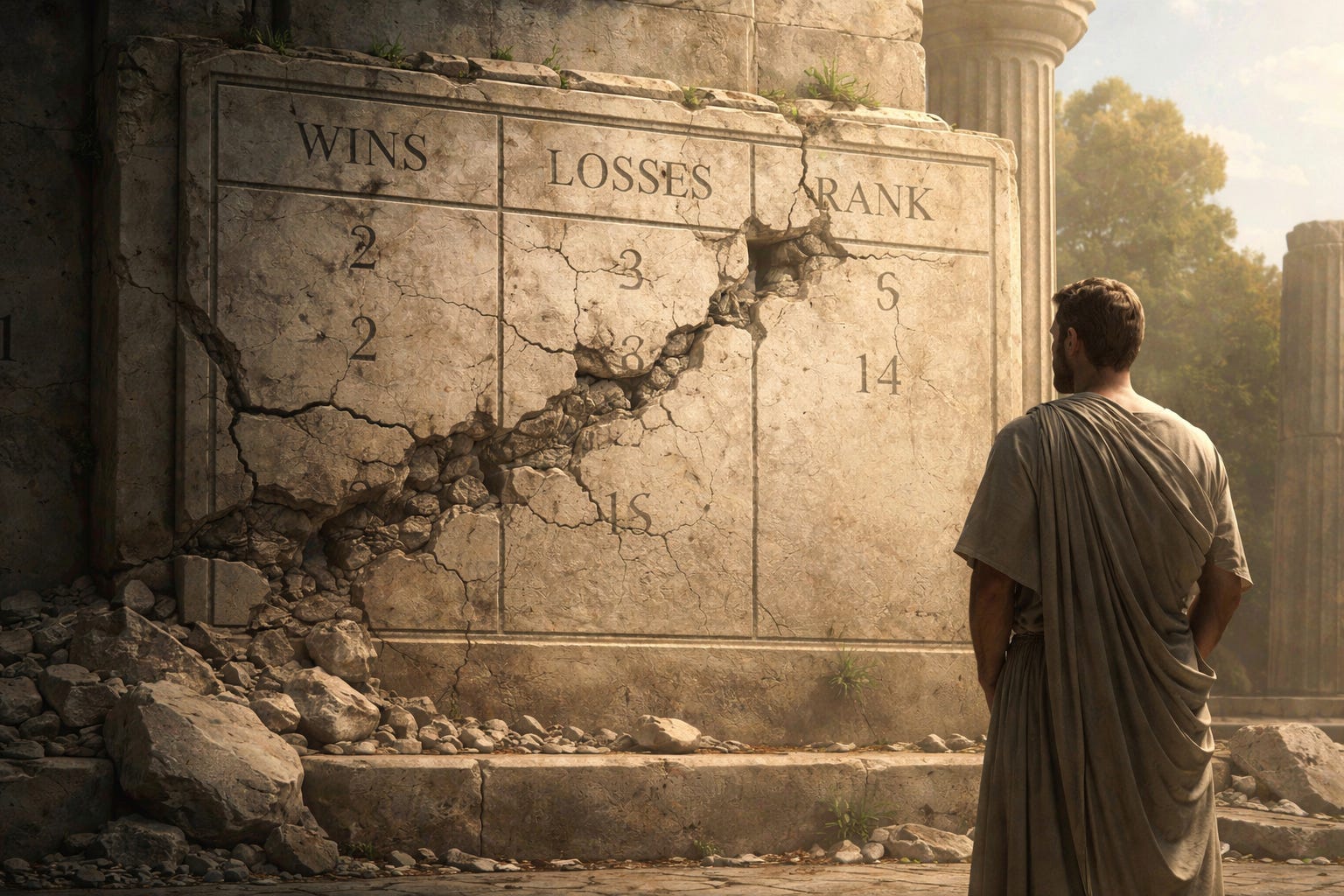
Modern Stoicism Is Reduced to a Sales Funnel
There is a growing tendency to treat Stoicism not as an ethical discipline but as a delivery mechanism—a way to smuggle modern success metrics into ancient language and sell them back as wisdom. Happiness, wealth, power, influence, optimization: the goals are assumed in advance, and Stoicism is conscripted to serve them.
This is not a philosophical disagreement. It is a category error.
Stoicism bows and conforms to no metric—it is the metric.
Stoicism is not a method for winning. It is not a productivity system, a mood regulator, or a strategy for personal advantage. It is an ethical framework concerned with one question only: what makes a life good, regardless of outcome? When Stoicism is repurposed to guarantee happiness, status, material gain, or “winning,” it has already been hollowed out. The conclusion has been chosen first; the philosophy is used afterward as branding.
That inversion matters. Any ethical system that judges actions by outcomes ceases to be ethical. It becomes instrumental. Virtue becomes a tactic. Discipline becomes a means to applause. And the moment virtue is justified by what it produces, rather than by what it is, Stoicism has been replaced by something else entirely—something far more familiar and far less demanding.
This post is not a debate between schools. It is a refusal to confuse philosophy with marketing.
Ethics Is Not Optimization
The core mistake behind this modern misuse of Stoicism is a simple one: it confuses an ethical framework with a performance system. These answer different questions, operate under different standards, and cannot be collapsed without distortion.
A performance system asks, how do I get better results?
An ethical system asks, what makes an action right, regardless of results?
Stoicism belongs entirely to the second category.
When someone imports pre-selected success metrics—happiness, wealth, power, influence—and then asks Stoicism to help maximize them, the philosophy has already been misapplied. Stoicism is not indifferent to results because it lacks ambition; it is indifferent to results because results do not determine ethical worth.
“Virtue is the only good; at least there is nothing good without virtue.”—Seneca, Letters, 71.32
This is the line modern “Stoic optimization” refuses to cross, and so it remains incomplete at best, a perversion at worst. If happiness, money, or status are treated as the goal, then virtue is no longer sovereign. It becomes instrumental—valuable only insofar as it pays off. That is not Stoicism; it is consequentialism in Greco-Roman robes.
The same error appears in the language of systems that “guarantee winning.” Optimization thinking assumes a controllable world: repeat the inputs, secure the outputs. Stoicism begins from the opposite premise—that the world is not controllable and that moral integrity must therefore be grounded in what is controllable: judgment, intention, and action.
“Some things are in our control and others not.”—Epictetus, Enchiridion, 1
A system can improve odds. It cannot guarantee outcomes. Stoicism never promises victory because it was forged in a world where victory is uncertain, temporary, and often irrelevant to the goodness of a life.
The category error, then, is not subtle. It is decisive. To treat Stoicism as a system for winning is to judge actions by what they produce rather than by what they are. The moment success becomes the measure, Stoicism has already been abandoned—even if its vocabulary remains.
Stoicism is not optimized for gain. It is optimized for rightness under constraint.
Goals, Systems, and the Stoic Order
There is a popular claim among so-called modern Stoics that Stoics do not set goals; they build “systems” that produce results without reference to explicit ends. This position is Stoic only in the most superficial sense. It is derived from a half-understood idea—that Stoics treat outcomes as indifferent and judge conduct, not results. While this is true in a narrow and technical sense, extending it to the conclusion that goals do not matter and systems replace ends is a distortion of Stoic philosophy, not an expression of it. This is not Stoicism. It is a misuse of Stoic indifference to justify intellectual laziness and moral drift.
This popular opposition between “goals” and “systems” collapses under even light Stoic scrutiny. Stoicism rejects neither. What it rejects is confusing their place in the moral hierarchy.
A Stoic may set goals. Ends are selected by reason in light of one’s roles and duties: to train the body, to educate the mind, to provide for family, to serve the community, to act justly in one’s station. To refuse to select ends would not be Stoic detachment; it would be abdication of duty.
“First say to yourself what you would be; and then do what you have to do.”—Epictetus, Discourses, III.23
What Stoicism forbids is allowing the goal’s outcome to become the measure of success. Ends guide action; they do not judge the self. Fate retains veto power over outcomes, and Stoicism refuses to argue with that reality.
Systems, likewise, have their place. Discipline, routine, training, repetition—these are not modern inventions, nor are they foreign to Stoic practice. But a system is a means, not a guarantee. It expresses commitment to right action; it does not certify victory.
“Do your duty, and leave the rest to fate.”
—Marcus Aurelius, Meditations, VI.2
The Stoic order is therefore precise and non-negotiable:
Virtue determines what ends are worth pursuing.
Reason selects goals consistent with duty.
Discipline governs the daily execution.
Outcome is accepted without moral attachment.
Reverse this order—place outcomes first, systems second, and virtue last—and Stoicism is undone. You are no longer acting because the action is right; you are acting because you want a particular result. At that point, virtue has become conditional.
Seneca is explicit about this inversion:
“The wise man looks to the purpose of all actions, not to the results.”
—Seneca, On the Happy Life, 20.2
This is why the language of “guaranteed winning” is fundamentally un-Stoic. Winning is not promised. Showing up is not “victory.” What is demanded is clean action under uncertainty—the discipline to act well when success is possible, unlikely, or already foreclosed.
Stoicism does not erase the finish line. It simply refuses to let the finish line define the worth of the runner.
Duty vs. Optimization—and the Stoic Measure of Success
The so-called “Stoicism” of modern “Stoic optimization” collapses two things classical Stoicism keeps rigorously separate: duty and results. In doing so, it replaces ethics with efficiency and then mistakes that replacement for philosophical progress.
Optimization asks, what works?
Stoicism asks, what is required?
Duty, in Stoicism, does not arise from desired outcomes. It arises from role, reason, and circumstance. One acts because the action is fitting—καθῆκον (kathēkon, appropriate action)—not because it promises advantage. To subordinate duty to optimization is to invert Stoicism’s moral hierarchy.
“In life our first job is this: to divide and distinguish things into two categories—externals I cannot control, but the choices I make with regard to them I do control.”—Epictetus, Discourses, II.5
Optimization frameworks evaluate actions by payoff: efficiency, growth, winning. Stoicism evaluates actions by quality of assent and execution. Whether the action “pays” is not the measure. Whether it was just, rational, and disciplined is.
This is why the rhetoric of “losers” and “winners” is alien to Stoic thought. Stoicism does not recognize social ranking as a moral category. A soldier who dies at his post has not “lost.” A statesman who is exiled for refusing corruption has not “failed.” A parent whose efforts do not yield gratitude has not been defeated. These are not rhetorical flourishes; they are direct implications of Stoic ethics.
“What matters is not what you bear, but how you bear it.”—Seneca, On Providence, 2.4
The proper Stoic measure of success is therefore internal and exacting:
Did I judge the situation clearly?
Did I choose in accordance with reason?
Did I act with justice, courage, temperance, and wisdom?
Did I fulfill my duty without attachment to outcome?
If the answer is yes, the Stoic has succeeded—even if the project fails, the enemy wins, the market crashes, or the body gives out.
“The wise man looks to the purpose of all actions, not to the results.”—Seneca, On the Happy Life, 20.2
This is precisely what instrumental and “systems” Stoicism cannot tolerate. A philosophy that treats virtue as a tactic must justify itself by outcomes. A philosophy that treats virtue as the standard has no such need. The former requires guarantees; the latter requires resolve.
Stoicism was never designed to make you happy, wealthy, or powerful. Those are externals, subject to chance, competition, and decay. Anyone who tells you different and claims to be Stoic is lying.
“Do not seek for events to happen as you wish, but wish for them to happen as they do happen, and your life will go smoothly.”—Epictetus, Enchiridion, 8
Stoicism was designed to make you reliable under pressure, clean in judgment, and unbroken by results. It does not optimize for winning. It prepares you to act rightly when winning is uncertain, unlikely, or irrelevant.
Stoicism is not a system for success.
It is a discipline for duty.
Conclusion
Stoicism does not need to be rehabilitated for modern life by turning it into a system for success. It was never broken. What is broken is the assumption—so common today—that a philosophy must justify itself by producing happiness, wealth, power, or visible wins.
Stoicism refuses that demand, and so do I.
Stoicism does not promise victory. It does not guarantee results. It does not redefine success so that everyone “wins” by showing up. It demands something far more severe: that you act rightly regardless of outcome, and that you accept whatever follows without moral collapse.
“If you wish to make progress, be content to be thought foolish and stupid.”—Epictetus, Enchiridion, 13
The modern fixation on systems that “guarantee winning” reveals an inability to tolerate uncertainty, loss, and obscurity. Stoicism was forged precisely for those conditions. It does not anesthetize them. It trains you to stand inside them without surrendering judgment or duty.
“The good of a rational being is conformity to reason.”—Marcus Aurelius, Meditations, VII.11
When Stoicism is repackaged as a tool for gain, virtue is reduced to a tactic and philosophy becomes branding. But virtue that depends on payoff is no virtue at all—it is bargaining with fate under a different name.
Stoicism does not ask whether your system works.
It asks whether your actions are worthy.
And when the system fails—as all systems eventually do—Stoicism remains, intact and demanding, because it never outsourced the good to results in the first place.
“The happy life depends on very little—and that little depends on ourselves.”—Seneca, Letters, 44.7
That is not marketing.
That is philosophy.
Amazing post. Thank you.