

Seeing America More Clearly From a Distance
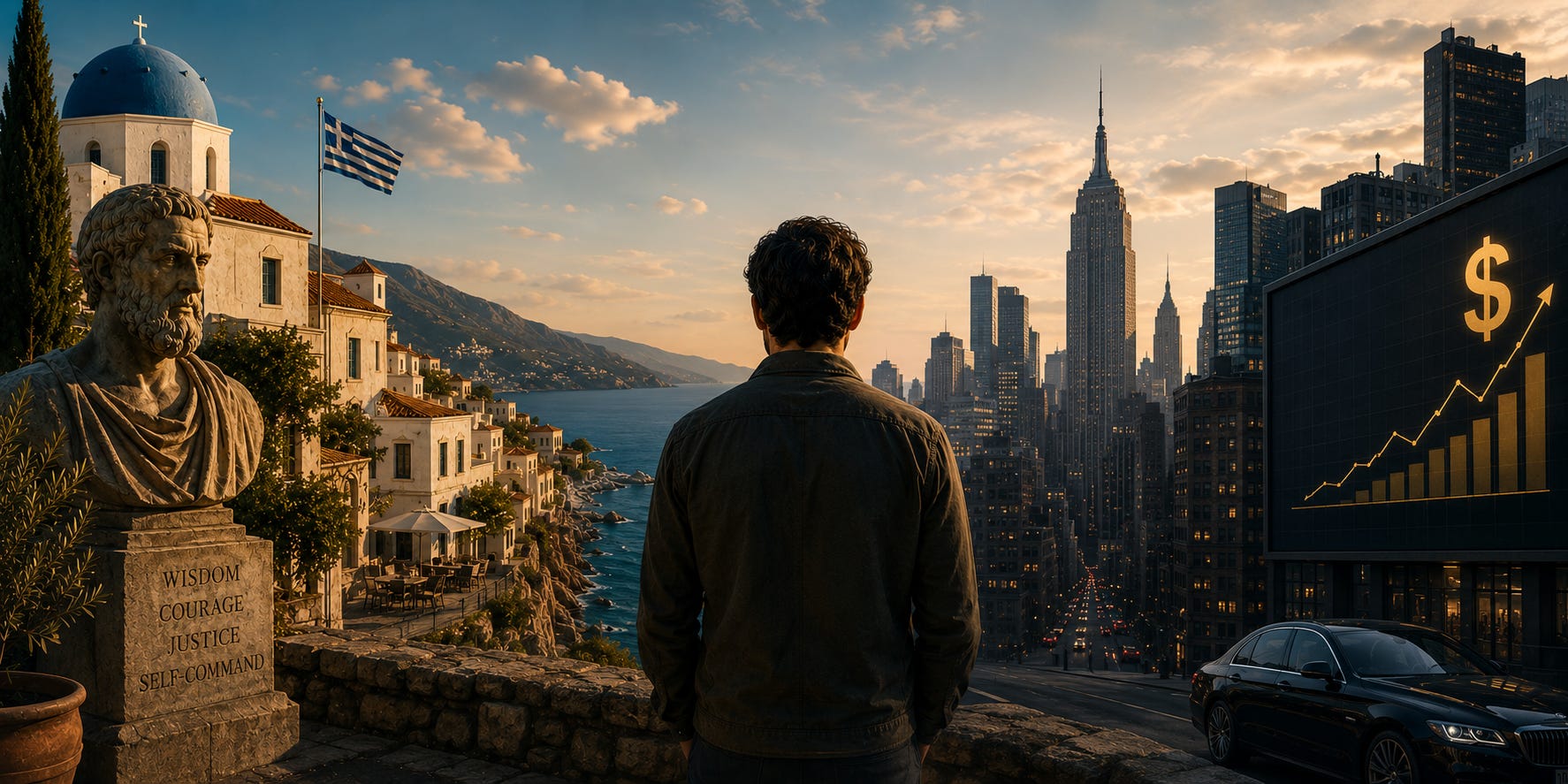
I am Greek. Born and raised in the United States, but with far more than a casual association with my ancestral home. I now split my time between both, with homes in both. I live between the American world that formed me and the Greek world that claims me as its own, just as I claim it. After a time, I realized I did not fully see American hyper-capitalism until I was no longer breathing its air every day.
That is not because Greece is a paradise. It is not. Greece has bureaucracy, inefficiency, corruption, gossip, economic frustration, and its own forms of vanity and status. No serious person should pretend otherwise. Nor are Greeks walking Stoic philosophers simply because they drink coffee slowly, value family, and resist the American cult of productivity.
But living in Greece off and on has made something visible to me that was harder to see from the inside: America does not merely have a capitalist economy. It has a runaway hyper-capitalist environment that presses itself into nearly every judgment. At its worst (a more and more common state), the United States becomes a single-axis culture, and that axis is money.
In the United States, money is not only a tool. It is treated as evidence. Evidence of intelligence. Evidence of discipline. Evidence of seriousness. Evidence of worth. Income, career rank, résumé value, institutional prestige, home ownership, productivity, visibility, and market demand become measures not merely of what a person has achieved, but of what a person is.
In the United States, you are your money.
While that sentence is too crude to be universally true, it is too true to dismiss.
I spent decades inside that world. I lived corporate life. I watched professional identity become personal identity. I watched the résumé become a substitute for character. I watched people speak of success as though it were a moral category. I watched the language of the market expand into nearly every domain of life: education, health, friendship, politics, morality, even the self.
Again, Greece is not morally pure. But the hierarchy of values is different. Money matters here, often painfully. Economic insecurity is real. Ambition exists. Status exists. Envy exists. Yet money does not seem to possess the same final authority. A person is not automatically reduced to income. For all its faults, there remains in Greek life a stubborn refusal to let the market define the whole person.
That matters.
In Greece, you are not simply what you do for a living. You are not simply what you own. You are not simply your bank account. At least not fully. Outside of wealth, you remain legible as a whole person: your character, your demeanor, your family obligations, your education, your social conduct, your regard for culture, your sense of honor, and your capacity to show respect all still matter.
This is not a “better than, worse than” discussion. It is a contrast that reveals a deep philosophical problem with hyper-capitalism.
Every society teaches its people what to admire. Every society trains desire. Every society has a hierarchy of goods, whether it admits it or not.
America taught me ambition. Greece taught me to question what ambition is for.
That question is where Stoicism enters.
Hyper-Capitalism, Not Merely Capitalism
The target is not capitalism as such.
Markets are not evil. Trade is not evil. Property is not evil. Profit is not evil. Ambition is not evil. A society needs production, exchange, incentives, competence, ownership, and reward. A serious critique cannot begin by pretending that wealth creation is itself a vice.
The problem is not capitalism.
The problem is hyper-capitalism, closely related to what many call late-stage capitalism.
Hyper-capitalism is the condition in which market logic escapes its proper domain and becomes the organizing principle of life itself. It is what happens when nearly everything is priced, ranked, monetized, branded, optimized, leveraged, or converted into exchange value.
Education becomes credential acquisition.
Health becomes billing architecture.
Friendship becomes networking.
Attention becomes inventory.
Privacy becomes data.
Morality becomes public branding.
Identity becomes market positioning.
Productivity becomes virtue.
Visibility becomes existence.
This is different from ordinary commerce. Commerce sells goods and services. Hyper-capitalism teaches the soul to understand itself as a good or service.
That is the real danger.
That is America now.
A market can tell us what someone will pay. It cannot tell us what something is worth. It can assign a price. It cannot assign dignity. It can measure demand. It cannot measure virtue. It can reward usefulness. It cannot determine human value.
Hyper-capitalism constantly blurs those categories. The rich become admirable because they are rich. The poor become suspect because they are poor. The productive become morally serious because they are productive. The inefficient become contemptible because they are inefficient. The visible become important because they are visible.
This is not merely an economic distortion. It is a spiritual and rational perversion.
Stoicism gives us the language for that distortion: false judgment.
The Stoic does not condemn wealth. He condemns servitude to wealth. He does not condemn ambition. He condemns ambition without reason. He does not condemn success. He condemns the confusion of success with virtue.
Hyper-capitalism is dangerous because it turns useful things into ultimate things. It takes what the Stoics would call externals—money, status, reputation, comfort, visibility, and success—and trains us to treat them as goods in themselves.
That is the inversion—and perversion.
The market has its place. Money has its place. Ambition has its place. But when the market becomes the measure of the soul, the soul has lost command of itself.
Externals Are Not Goods
Stoicism does not ask whether a man is rich. It asks whether he is ruled.
That distinction is essential. Stoicism is not a philosophy of poverty, resentment, or withdrawal. It does not require contempt for money. It does not require failure dressed up as virtue. It does not require a man to abandon ambition, refuse success, or pretend that material conditions are not relevant.
Wealth matters. Health matters. Stability matters. Reputation matters. Competence matters. The ability to provide for oneself and one’s family matters. No serious philosophy can treat these things as nothing.
But Stoicism does not call them goods.
For the Stoic, virtue is the only true good: wisdom, courage, justice, and self-command. Vice is the only true evil. Everything else belongs to the realm of externals. Some externals are naturally preferred: health over sickness, stability over chaos, wealth over poverty, honor over disgrace. But none of them define the worth of a human being.
That is the point modern American life has lost.
Money can expand action. It can buy time, security, education, movement, shelter, medical care, and opportunity. Used well, it can support responsibility and service. Used badly, it becomes anesthesia, vanity, domination, or escape.
Money is an instrument. It is not a verdict.
That is America’s mistake.
The same is true of status, achievement, productivity, and reputation. They are not meaningless. They are also not final. A man may have rank and be hollow. He may have wealth and be servile. He may have credentials and lack wisdom. He may be admired and still be disordered.
Stoicism is severe on this point because it refuses to confuse usefulness with goodness.
The question is not whether wealth is useful; of course it is. The question is whether wealth makes a man good. It does not. The question is not whether success is preferable to failure; of course it is. The question is whether success proves virtue. It does not.
The Stoic may possess wealth. He may pursue excellence. He may build, compete, earn, and command. But he must know what these things are. They are tools. They are materials. They are tests of judgment.
They are not the measure of the soul, whatever American hyper-capitalism would have us believe.
America’s Error: Turning Preferred Indifferents Into Gods
The American error is not ambition.
Ambition is one of America’s great forces. Properly ordered, it produces discipline, invention, courage, endurance, and extraordinary practical achievement. The United States has built much of its strength on the belief that a person can act, rise, build, improve, and refuse the limits assigned to him. That is not a small thing. It is one of the reasons America remains powerful.
The error begins when ambition loses its master.
When ambition serves virtue, it is noble. When ambition serves only acquisition, it becomes servitude with better clothing.
This is where American hyper-capitalism now stands. It does not merely reward external success. It trains people to treat external success as proof of inner worth.
In the United States…
Income becomes evidence of intelligence.
Productivity becomes evidence of seriousness.
Visibility becomes evidence of importance.
Institutional prestige becomes evidence of character.
Busyness becomes evidence of value.
Exhaustion becomes evidence of commitment.
Wealth becomes evidence that one has lived correctly.
This is a false hierarchy.
A high income may show market demand. It may show skill, timing, discipline, aggression, inheritance, luck, or proximity to power. It does not necessarily show wisdom. A full calendar may show responsibility. It may also show slavery. A successful career may show excellence. It may also show cowardice, conformity, vanity, or fear of being ordinary.
Hyper-capitalism flattens these distinctions. It turns every question into an economic question, then mistakes the answer for a moral one.
That is the danger.
The United States is not uniquely vicious. It is not a cartoon villain. It is not a civilization without virtue. It contains generosity, courage, brilliance, work ethic, innovation, and an unmatched capacity for reinvention. But its now dominant culture often pushes those strengths through a single narrowing gate: market value.
What can be monetized is treated as serious.
What can scale is treated as important.
What can be measured is treated as real.
What can be branded is treated as meaningful.
And what cannot be priced begins to disappear from view.
That is not merely an economic problem. It is a problem of judgment. A society that forgets the difference between price and worth trains its people to misread themselves, misread one another, and misread the good.
The Stoic objection is therefore not that America rewards success. Success is not the enemy. The objection is that America now too often worships success before asking what kind of man has succeeded, what he has served, what he has sacrificed, and what he has become while maintaining virtue.
That is the question hyper-capitalism avoids.
One look at America’s leadership, and it becomes evident these questions are no longer being asked.
Stoicism refuses to avoid these questions.
What Hyper-Capitalism Trains the Soul to Worship
The real contrast is not between America and Greece. That contrast is only how the problem became clear to me.
The more profound contrast is between two hierarchies of value.
Stoicism teaches that virtue is the only true good. Wealth, status, comfort, reputation, success, and power may be useful, even preferable, but they are not good in themselves. They do not make a man wise. They do not make him just. They do not make him courageous. They do not make him free.
Hyper-capitalism teaches the opposite.
It teaches that what can be monetized is more real than what cannot. It teaches that what can be scaled is more serious than what is merely human. It teaches that what can be measured is more important than what must be judged. It teaches that success is not simply useful, but sacred.
That is not a small error. It is a corruption of ethical and moral vision.
A society ruled by hyper-capitalism does not merely reward wealth. It trains admiration for wealth. It does not merely require productivity. It turns productivity into identity. It does not merely use status. It converts status into evidence of worth. It does not merely tolerate ambition. It removes nearly every limit on ambition except failure.
This is why hyper-capitalism is ethically dangerous. It forms the soul badly.
It teaches envy and calls it aspiration.
It teaches vanity and calls it branding.
It teaches exhaustion and calls it commitment.
It teaches greed and calls it growth.
It teaches self-display and calls it relevance.
It teaches servitude to externals and calls it success.
From a Stoic perspective, this is not merely inefficient, unfair, or unpleasant. It is disordered and corrupt. It trains people to love what should be used, to fear what should be endured, and to worship what should be governed.
That is the central failure.
Hyper-capitalism takes the useful and makes it ultimate. It takes externals and makes them gods. It takes the market, which should serve human life, and teaches human life to serve the market.
America no longer serves Americans; Americans serve the American market, and there is very little remaining of America beyond that market.
Stoicism cannot and will not accept that inversion.
The Stoic may earn money. He may build. He may compete. He may lead. He may succeed. But he must never forget the rank of things. Wealth is below virtue. Status is below character. Productivity is below wisdom. Reputation is below justice. Comfort is below self-command.
A civilization that forgets this does not merely become unequal or anxious. It becomes confused about what human life is for.
And once that confusion becomes normal, the soul no longer needs chains; it will volunteer for enslavement.
What the Stoic Must Refuse
The Stoic must stop volunteering to be shackled to material worth.
He does not need to flee the market. He does not need to hate wealth. He does not need to despise success. He does not need to pretend that material life is irrelevant. That would be childish, not philosophical.
But he must refuse false rank.
He must refuse to measure himself by income.
He must refuse to confuse productivity with virtue.
He must refuse to let reputation govern conscience.
He must refuse to turn every relationship into an advantage.
He must refuse to admire wealth before examining character.
He must refuse to treat exhaustion as nobility.
He must refuse to call ambition good merely because it is intense.
He must refuse to let comfort become necessity.
He must refuse to let market value define human value.
This refusal is not resentment. It is not weakness. It is not an excuse for failure.
It is discipline.
The man who cannot refuse external judgment is not free. He may be rich, praised, promoted, admired, and envied, but if his soul rises and falls with income, applause, status, and visible achievement, then he is governed from outside himself.
That is slavery in respectable clothing.
A Stoic living inside hyper-capitalism must therefore practice a kind of inner separation. He may work. He may earn. He may compete. He may build. He may win. But he must keep the market outside the citadel of judgment.
He must know the difference between being useful and being good.
He must know the difference between being successful and being wise.
He must know the difference between being admired and being honorable.
He must know the difference between being comfortable and being free.
This is not easy, because hyper-capitalism does not merely tempt the appetite. It surrounds judgment. It speaks through institutions, advertising, status, career incentives, academic prestige, professional identity, social media, family expectations, and the quiet humiliations of comparison.
Hyper-capitalism continuously tells the man that he is behind.
Behind whom?
Behind what?
By what standard?
These are the questions the Stoic must ask.
The answer cannot and must not ever be supplied by the market. The market has no doctrine of the good. The market is a perfect amoral machine. It only has price, demand, scarcity, leverage, and incentive. While these may be useful mechanisms, they are not moral authorities and must never be treated as such.
The Stoic refuses to let mechanism become master.
The Stoic must refuse to believe that a full calendar proves a full life. He must refuse to believe that expensive things imply refined judgment. He must refuse to believe that visibility is significance. He must refuse to believe that being envied is the same as being excellent.
Above all, the Stoic must refuse the central lie: that the external world can tell him what his soul is worth.
It cannot.
What the Stoic May Still Do
Above all, remember refusal is not withdrawal.
This distinction matters. A Stoic critique of hyper-capitalism is not an argument for passivity, poverty, mediocrity, or retreat from the world. The Stoic is not required to become harmless. He is not required to become economically useless. He is not required to pretend that competence, strength, and achievement do not matter.
Of course they do matter.
The Stoic may earn money.
He may build wealth.
He may own property.
He may lead institutions.
He may compete seriously.
He may seek excellence in his profession.
He may provide for his family.
He may pursue rank when rank gives him greater ability to serve.
He may use power when power is subordinated to reason.
The issue is not action. The issue is command.
Does he command the tools, or do the tools command him? This question cannot be answered casually or simply. It deserves the deepest scrutiny and the harshest critique without rationalizations.
Money in the hands of a disciplined man can protect a family, support education, create independence, fund service, resist coercion, and expand the range of honorable action. Money in the hands of a disordered man amplifies disorder. It buys luxury without peace, influence without wisdom, stimulation without purpose, and status without nobility.
The same is true of ambition.
Ambition governed by virtue can produce mastery. Ambition governed by vanity produces servitude. Ambition governed by justice can build institutions. Ambition governed by appetite builds monuments to the self. Ambition governed by wisdom knows when to act, when to endure, when to advance, and when to stop.
The Stoic is not anti-success.
He is anti-idolatry.
The Stoic does not reject the marketplace. He rejects kneeling in it. He does not reject productivity. He rejects making productivity the definition of the self. He does not reject wealth. He rejects the fantasy that wealth can do the work of virtue. It cannot.
This is where Stoicism is harder than both indulgence and resentment.
It is easy to worship wealth.
It is also easy to resent wealth.
It is harder to use wealth without worshiping it or resenting it.
That is the Stoic discipline, and that is the flaw in modern US culture. Half worship wealth. Half resent it. Both are slaves to the market from opposite ends.
To live well inside hyper-capitalism, the Stoic must be competent enough to function within the system and free enough not to be defined by it. He must understand the rules of the market without confusing those rules with the laws of the soul.
He must make money without becoming money’s servant.
He must pursue excellence without turning excellence into vanity.
He must build a life that can withstand both gain and loss.
Put the Market Back in Its Place
The market is a tool.
It is a powerful tool, often useful, often necessary, often productive. It can coordinate labor, allocate resources, reward competence, punish waste, and create prosperity. No serious person should deny its force or the value well-regulated capitalism provides.
But a tool must remain a tool, and this is where America is failing. The tool is now the master. American capitalism is now a creature in its own right and is consuming what America once was. Worse yet, instead of reigning in this monster, America is doubling down, convinced greatness lies on the other side of supercharged hyper-capitalism.
Leaders are now just clownish caricatures of “the rich man.”
CEOs are performative characters reminiscent of 1980s professional wrestlers, complete with props and bad storylines.
Ignorant influencers carry more authority than the learned and schooled in their field, simply based on the monetization of followers.
Art is just what sells, not what uplifts the soul.
People are no longer human; they are brands, and those without a sellable brand cease to be human.
When the market becomes the final judge of human worth, the hierarchy of life has been inverted. When money becomes evidence of virtue, when productivity becomes identity, when success becomes sacred, when visibility becomes existence, the soul has lost the rank of things.
That is the Stoic objection to hyper-capitalism.
Not that it creates wealth or that it rewards ambition. Not that it honors competence or that it produces unequal outcomes. Those may be debated politically and economically. The deeper objection is philosophical: hyper-capitalism teaches false judgment. It teaches human beings to locate virtue outside themselves, in money, rank, applause, consumption, comfort, and market recognition.
Stoicism begins by rejecting that lie.
The good is not income.
The good is not status.
The good is not luxury.
The good is not visibility.
The good is not victory in the marketplace.
The good is virtue.
Wisdom, courage, justice, temperance, and self-command must rule above wealth and above the market if virtue is to be cultivated.
Everything else must be placed below that.
America taught me ambition, and I do not discount that. Greece taught me to question what ambition serves. Stoicism gives the answer: ambition is good only when governed by virtue. Wealth is good only when used by virtue. Success is good only when it does not corrupt virtue. Power is good only when it remains subordinate to virtue.
This is the proper rank of things.
The market may serve the household, the city, the country, the profession, and the common life. It may help build, protect, and provide. But it must never be allowed to define the good, because the market can only measure price.
It cannot measure the soul.
Any civilization that forgets that difference has begun to lose command of itself, and in that loss, the trajectory and outcome are clear. Clear, that is, for anyone who cares to look past the lie of hyper-capitalism with a critical Stoic eye.