

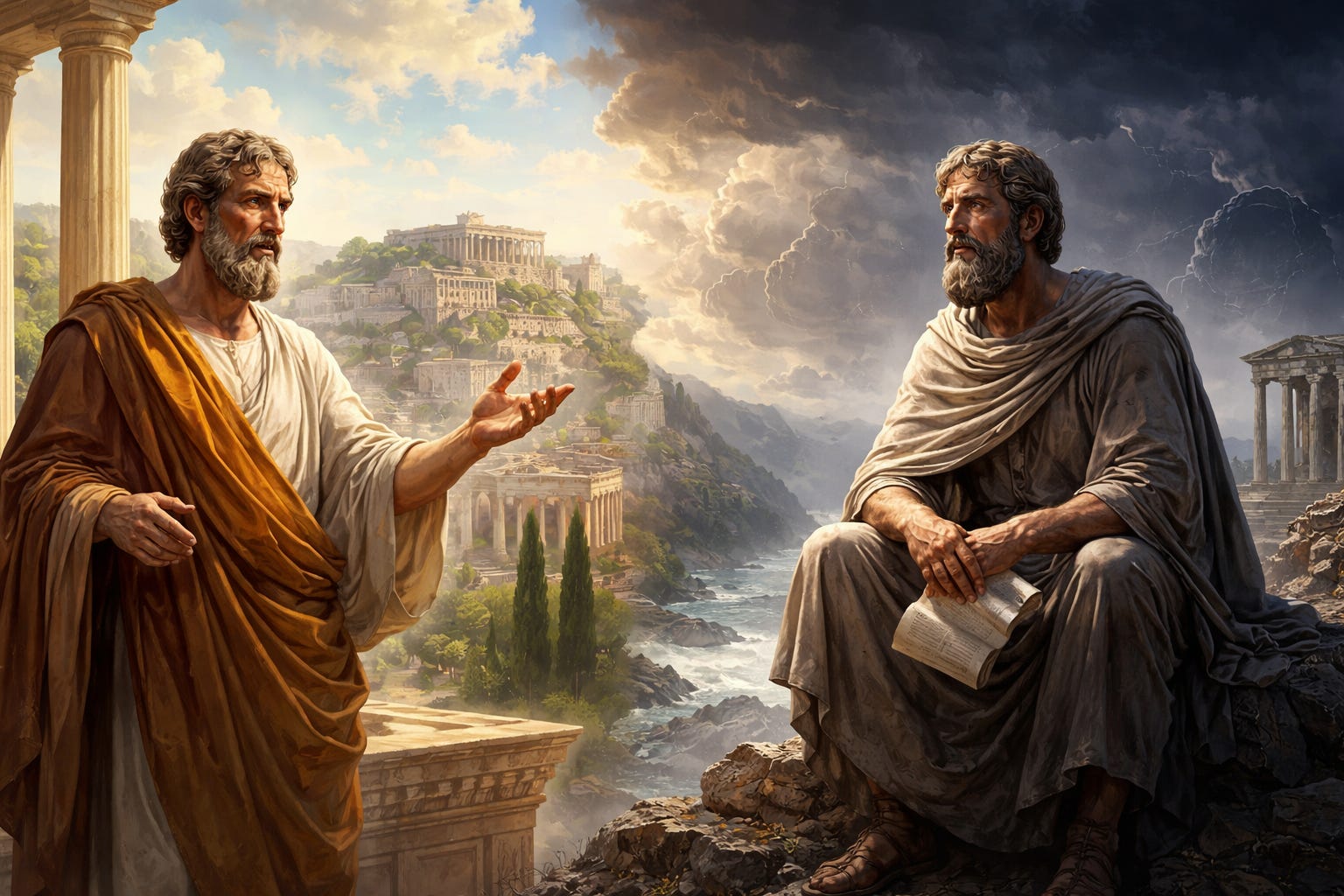
Framing: Comparison Is Harder Than It Seems
Among the classical philosophies, Aristotelian virtue ethics is the one most often confused with Stoicism—for understandable reasons. Both speak the language of virtue rather than pleasure. Both emphasize character over rules, habituation over impulse, reason over appetite. Both reject the idea that a good life is reducible to comfort or sensation (e.g., Epicureanism). On the surface, they appear to be allies.
That surface agreement is precisely what makes the comparison faulty.
When two systems share vocabulary, it becomes easy to assume they share conclusions. But philosophical differences are rarely obvious at the beginning. They emerge under pressure. When fortune turns, when capacity narrows, when life does not cooperate, is when fault lines appear.
The purpose of this comparison is not to adjudicate which philosophy sounds nobler or feels kinder. It is to ask a harder question, the question both philosophies attempt to answer: what, exactly, makes a life good—and can that goodness be injured by circumstance or luck?
Aristotle and the Stoics give different answers to that question, and the difference is not academic; it’s foundational and practical. It determines how one understands aging, illness, loss, disgrace, and duty. It determines whether a good person can be said to have lived a diminished life through no fault of their own—or whether virtue remains whole regardless of circumstance.
The line between these two philosophies is subtle but decisive.
Aristotelian Virtue Ethics, Fairly Presented
Aristotle’s ethics begins with a practical question: what does it mean for a human being to flourish? His answer is not a mood, a moment, or a private feeling, but εὐδαιμονία (eudaimonia)—a life that goes well as a whole, measured across time.
Flourishing, for Aristotle, is the activity of the soul in accordance with ἀρετή (virtue or excellence). Virtue is not innate; it is acquired through habituation—repeated right action guided by reason until excellence of character becomes stable. Central to this process is φρόνησις (practical wisdom): the cultivated ability to judge what is appropriate, here and now, given the particulars of a situation. Virtue is not rigid rule-following but trained discernment.
“The human good proves to be activity of the soul in accordance with virtue.”—Aristotle, Nicomachean Ethics, I.7
“Virtue makes the goal right, practical wisdom the things leading to it.”—Aristotle, Nicomachean Ethics, VI.12
Aristotle’s account is deeply human. He recognizes that we are embodied, social, and political creatures. We do not flourish in isolation, nor do we exercise virtue in a vacuum. Friendship, participation in the life of the community, and the ability to act meaningfully in the world are essential to a fully human life.
“Moral virtue comes about as a result of habit… we become just by doing just actions.”—Aristotle, Nicomachean Ethics, II.1
“Friends are thought to be the greatest of external goods.”—Aristotle, Nicomachean Ethics, IX.9
It is here that Aristotle makes his most controversial and honest claim: virtue alone is not sufficient for εὐδαιμονία (flourishing). A good life also requires certain external goods. Health matters, because severe illness can cripple action. Friends matter, because a solitary life is incomplete. Some measure of material stability matters, because extreme deprivation constrains agency. And fortune matters, because catastrophic bad luck can overwhelm even a well-formed character.
“For one swallow does not make a summer… nor does one day make a man blessed and happy.”—Aristotle, Nicomachean Ethics, I.7
Aristotle does not suggest that virtue loses its worth in misfortune. A virtuous person remains admirable even under hardship. But admiration is not the same as flourishing. Tragedy, in Aristotle’s framework, is real. A life can be morally serious, well-intentioned, and skillfully lived—and still fall short of full εὐδαιμονία (flourishing) through no fault of the person living it.
This is not softness or moral compromise. It is a tragic realism about the human condition. Aristotle refuses to pretend that character alone can neutralize all external blows. A good life, on his account, is excellent—but vulnerable, dependent in part on the cooperation of the world.
It is a powerful, humane vision.
It is also the point at which Stoicism will part ways.
Stoicism’s Counterclaim: Virtue Is Sufficient
Stoicism responds to Aristotle’s tragic realism with a harsher, narrower claim: the goodness of a life cannot be injured by luck. Where Aristotle allows fortune to complete or frustrate flourishing, Stoicism removes fortune from the moral equation entirely. This is not because Stoics deny the reality of loss, illness, or deprivation, but because they deny these things the status of good or evil.
The Stoic position begins with a radical compression of value. Virtue alone is good; vice alone is bad. Everything else—health and sickness, wealth and poverty, honor and disgrace—belongs to a separate category altogether and is removed from the equation.
“Virtue is the only good; at least there is nothing good without virtue.”—Seneca, Letters, 71.32
This is the decisive separation. Aristotle situates virtue within a broader account of flourishing; Stoicism identifies virtue as the good itself.
External conditions are not dismissed as unreal. They are classified. Epictetus draws the boundary with precision: what lies within our control is judgment, choice, and assent; what lies outside it is the body, possessions, and reputation.
“Some things are in our control and others not.”—Epictetus, Enchiridion, 1
“Not in our control are body, property, reputation, offices.”—Epictetus, Enchiridion, 1
By locating the good exclusively in what cannot be taken by force, accident, or time, Stoicism renders the good life sovereign. Fortune may constrain action, limit capacity, and impose suffering, but it cannot make a life morally worse unless it induces vice.
This is why the Stoics insist that virtue is sufficient for happiness—not because life becomes painless, but because happiness is no longer dependent on circumstances.
“They say that virtue is sufficient for happiness.”—Diogenes Laertius, Lives of the Eminent Philosophers, VII.127
The Stoic does not deny that illness impairs the body or that exile constrains opportunity. He denies that these things impair the goodness of the life being lived. Suffering changes the conditions under which virtue is exercised; it does not negate virtue itself. Marcus Aurelius states the practical implication with characteristic bluntness:
“If you are distressed by anything external, the pain is not due to the thing itself, but to your estimate of it.”—Marcus Aurelius, Meditations, VIII.47
This is not consolation. It is hierarchy. Aristotle grants that misfortune can wound flourishing. Stoicism refuses to allow the good to be placed anywhere that fate can reach it.
That refusal—more than temperament, more than tone—is the true line of separation.
The Fault Line: Can Luck, or Age, or Misfortune—Damage Virtue?
The decisive separation between Aristotle and the Stoics appears when fortune presses hardest. The question is simple and unforgiving: can external circumstances—luck, loss, illness, or old age—damage the goodness of a life?
Aristotle answers yes. Because εὐδαιμονία (eudaimonia, flourishing) includes effective activity in the world, it is vulnerable to the world’s refusal to cooperate. Severe misfortune can obstruct noble action and thereby diminish flourishing, even when character remains intact.
“It is impossible, or not easy, to do noble acts without the proper equipment.”—Aristotle, Nicomachean Ethics, I.8
For example, age, on this account, is not morally neutral. As capacities narrow, the range of actions through which virtue is expressed contracts. A life can remain admirable and yet fall short of full flourishing simply because age can diminish capacity. Tragedy is real because fate can wound the good life itself.
The Stoics reject this vulnerability outright. They relocate the good so that no external condition can reach it. What is subject to luck—body, health, status, time—is excluded from the category of good and evil. Age, illness, exile, misfortune are acknowledged as real and consequential but morally indifferent.
“Do not seek for events to happen as you wish, but wish for them to happen as they do happen, and your life will go smoothly.”—Epictetus, Enchiridion, 8
This does not minimize loss; it reclassifies it. Misfortune alters the instruments through which virtue operates, not virtue itself. The Stoic does not ask whether misfortunes reduce flourishing; they ask whether they impede justice, courage, temperance, or wisdom. They do not—unless one assents to that conclusion.
“Sickness is a hindrance to the body, but not to the will, unless the will itself chooses it.”—Epictetus, Discourses, I.18
For example, where Aristotle sees aging as a potential diminishment of the good life, Stoicism sees a change of theater. The stage narrows; the play does not end. Duty persists precisely because it is grounded in character, not capacity.
“What matters is not what you bear, but how you bear it.”—Seneca, On Providence, 2.4
This is why Stoicism can speak coherently about misfortune without denial and without tragedy. Misfortune may take strength, speed, endurance, resources, loved ones, possessions. It does not take the good—unless one has placed the good in what time and misfortune can steal.
“No man is unhappy except by his own fault.”—Seneca, Letters, 85.28
The fault line, then, is not temperament but metaphysics. Aristotle allows the good life to be injured by luck. Stoicism refuses to make the good hostage to anything external. For anyone subject to misfortune but still answering to duty, that refusal is not comforting. It is necessary.
Stoicism Wins the Test of Adversity
Aristotle offers a compelling account of the good life—so long as the world cooperates. His ethics are calibrated for a functioning πόλις (polis): stable institutions, intact health, enduring friendships, and sufficient fortune to sustain noble action. In such conditions, Aristotelian virtue ethics explains flourishing with unmatched clarity and humanity.
But philosophy is tested not by fair weather, but by exposure.
When Aristotle says, “It is impossible, or not easy, to do noble acts without the proper equipment,” he is being honest and exposing his limit. When fortune withdraws its support, flourishing becomes fragile. The virtuous person may remain admirable, yet the life itself can be diminished.
Stoicism is built for far harsher terrain. It assumes instability as the default and prepares the soul accordingly. Where Aristotle requires a cooperative world to complete εὐδαιμονία (eudaimonia, flourishing), Stoicism refuses to place the good anywhere that chance can reach.
“Virtue alone is sufficient for happiness.”—Diogenes Laertius, Lives of the Eminent Philosophers, VII.127
This is why the difference is not stylistic but structural.
Aristotle works best in a stable polis. Stoicism works in exile.
The Stoic good does not depend on institutions, health, reputation, or time remaining. It depends on judgment, assent, and duty—resources that persist even when everything else remembers its claim.
“Some things are in our control and others not.”—Epictetus, Enchiridion, 1
Aristotle explains flourishing; Stoicism explains endurance.
Stoicism does not promise completion or fullness. It promises sovereignty of the moral will under pressure—when completion is no longer possible.
“No condition can make the wise man miserable.”—Seneca, Letters, 85.28
Aristotle teaches how to live well when life goes right; Stoicism teaches how to live rightly when it does not.
That distinction matters where age advances, capacity narrows, and luck turns indifferent or hostile. In those conditions, a philosophy that requires favorable externals to secure the good has already conceded too much.
Stoicism does not deny loss. It denies loss the power to judge the life.
“If you are distressed by anything external, the pain is not due to the thing itself, but to your estimate of it.”—Marcus Aurelius, Meditations, VIII.47
This is why Stoicism wins the test of adversity—not because it is comforting, but because it is durable. It locates the good where neither age nor fortune can diminish it, and it demands duty precisely when circumstances make duty costly.
For those who must live not only when life goes right, but when it does not, Stoicism is not the gentler philosophy. It is the necessary one.
That’s why, for me, it is the necessary one.